
Accelerator
& Incubator Software
Tired of juggling tools? Nurture startups, connect mentors,
and showcase results—all in one dynamic hub.
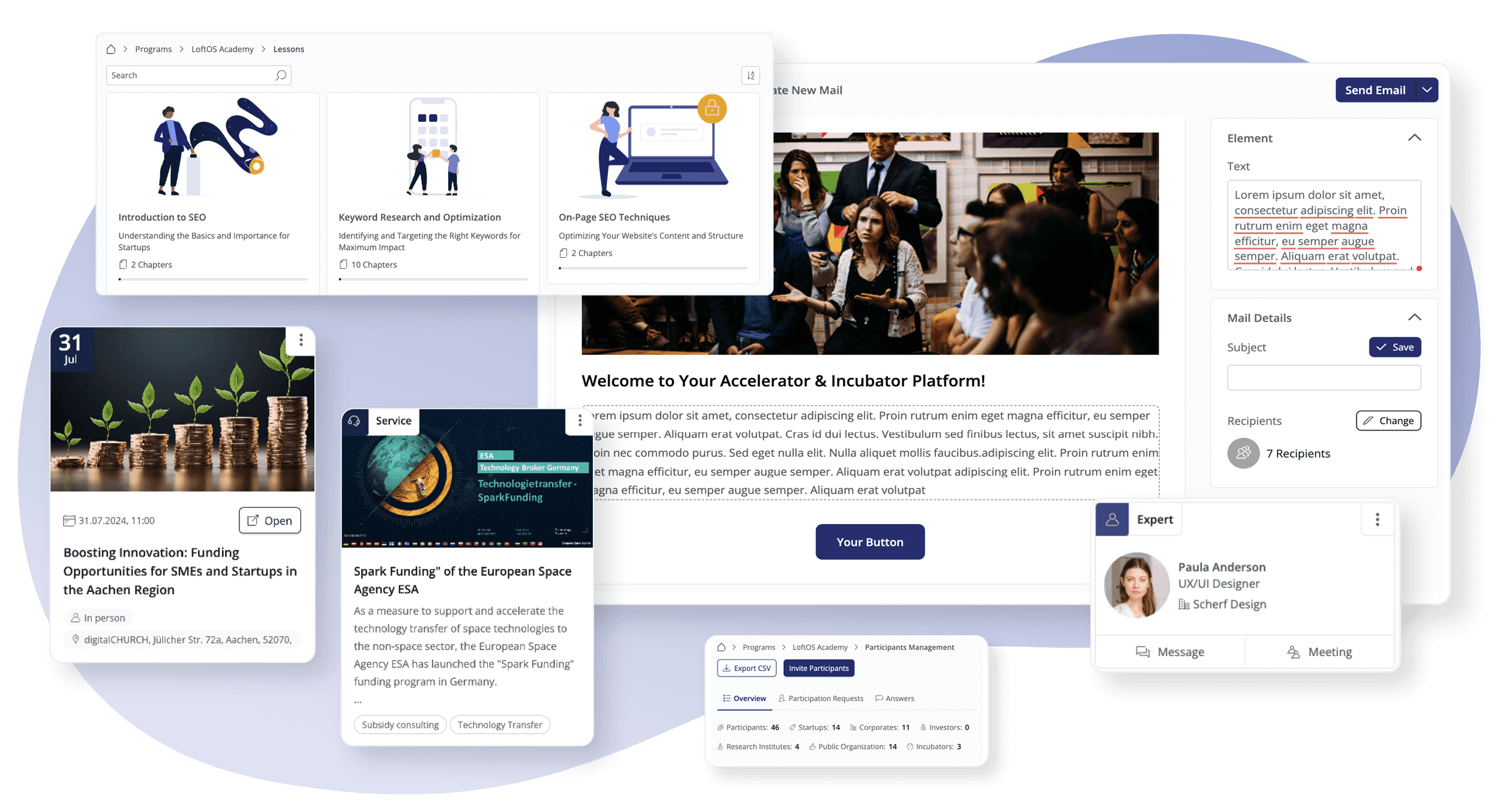
Think big, grow fast, scale smart
SPARK
Vibrant networks that propel startups from concept to market-ready powerhouses.
FORGE
Lasting alumni bonds that transform past participants into invaluable ecosystem assets.
ELEVATE
Data-driven insights that showcase your program's tangible impact to stakeholders.
CULTIVATE
A digital sanctuary where startups absorb knowledge and accelerate growth effortlessly.
Application overload
slowing you down?
Cut through the application clutter with a platform that saves you hours. Easily manage hundreds of startups without breaking a sweat or missing unicorn gems.
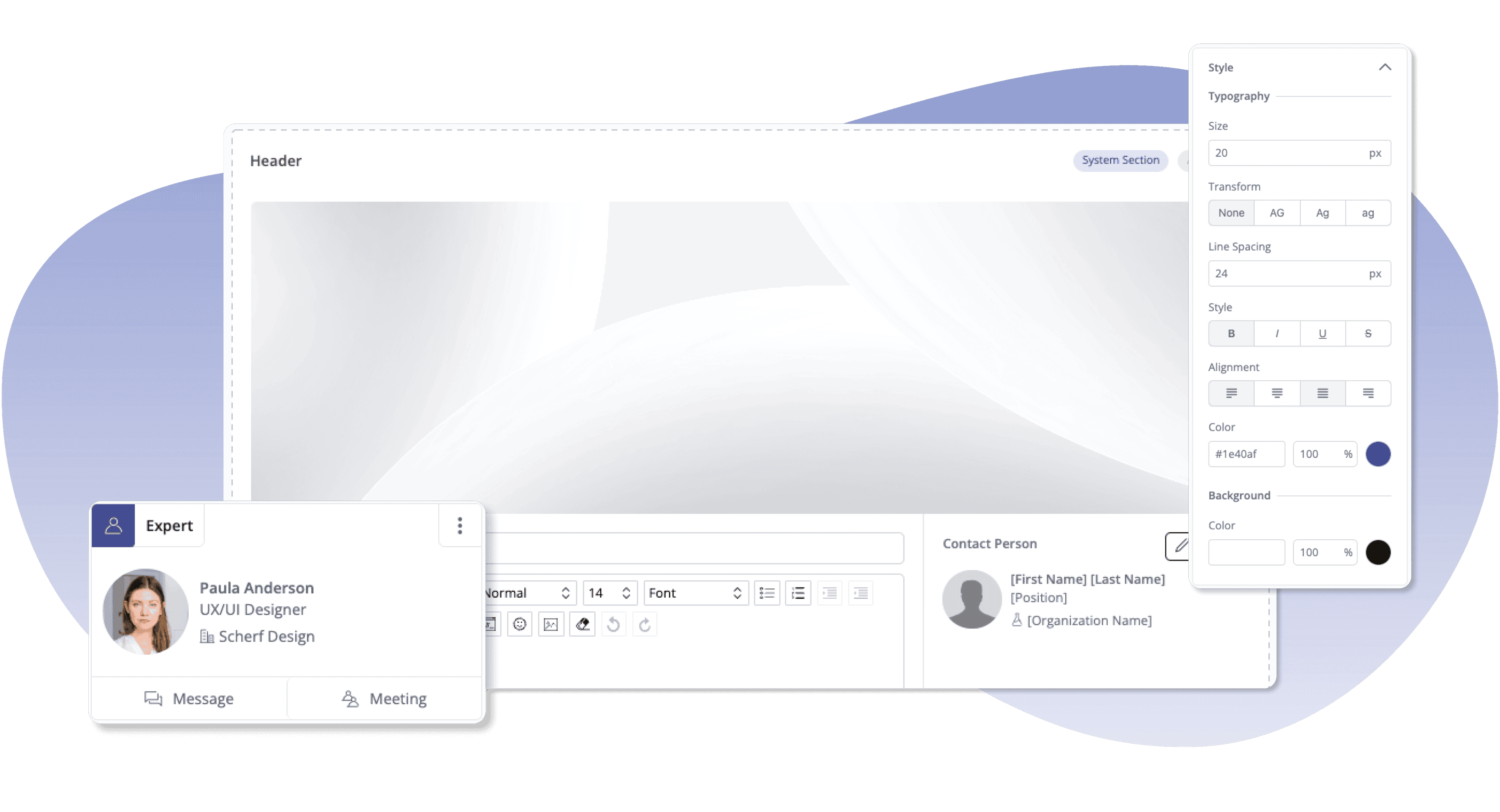
Easy application management
Craft tailored application forms that capture exactly what you need, minus the hassle of juggling multiple tools.
Visualize selection process
Transform your selection process into an intuitive journey. Move applicants through stages with a simple drag-and-drop.
Community at glance
Your entire startup community, organized and searchable in seconds. Every member, every detail, right where you need it.
Is there a way to make mentor-startup matchmaking easier?
We say yes.
Find the right mentor for every startup in your program in minutes,
not days. Meet a powerful matching algorithm that drive startup success and keep mentors engaged.
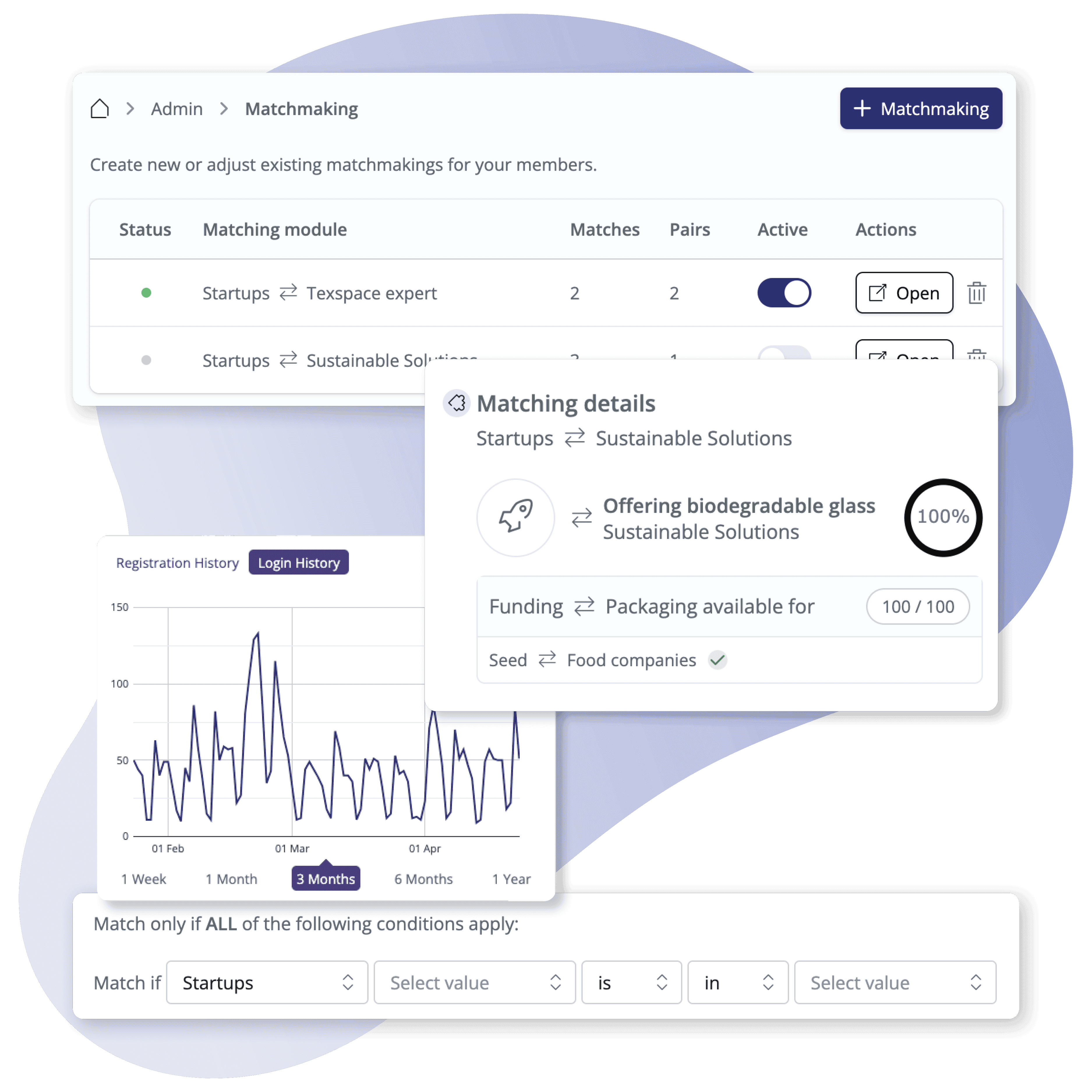
Smart connections
Define precise matching criteria to ensure your startups and mentors find their perfect counterparts effortlessly.
Automated matchmaking
Speed up valuable connections. Tailor matches to specific needs, from founders to coaches, with customizable importance levels.
Synced networking
Don't play matchmaker the hard way. Power up of your entire ecosystem. Cross-sync data for matches that feel like mind-reading.
Insight goldmine
Take a closer look behind the scenes. Track engagement, analyze interactions, and make data-driven decisions to boost your program's success.
Is your curriculum a black box? Crystal-clear startup
journeys, always.
Give cohorts a roadmap to success and watch them thrive with a transparent,
easy-to-track learning experience.
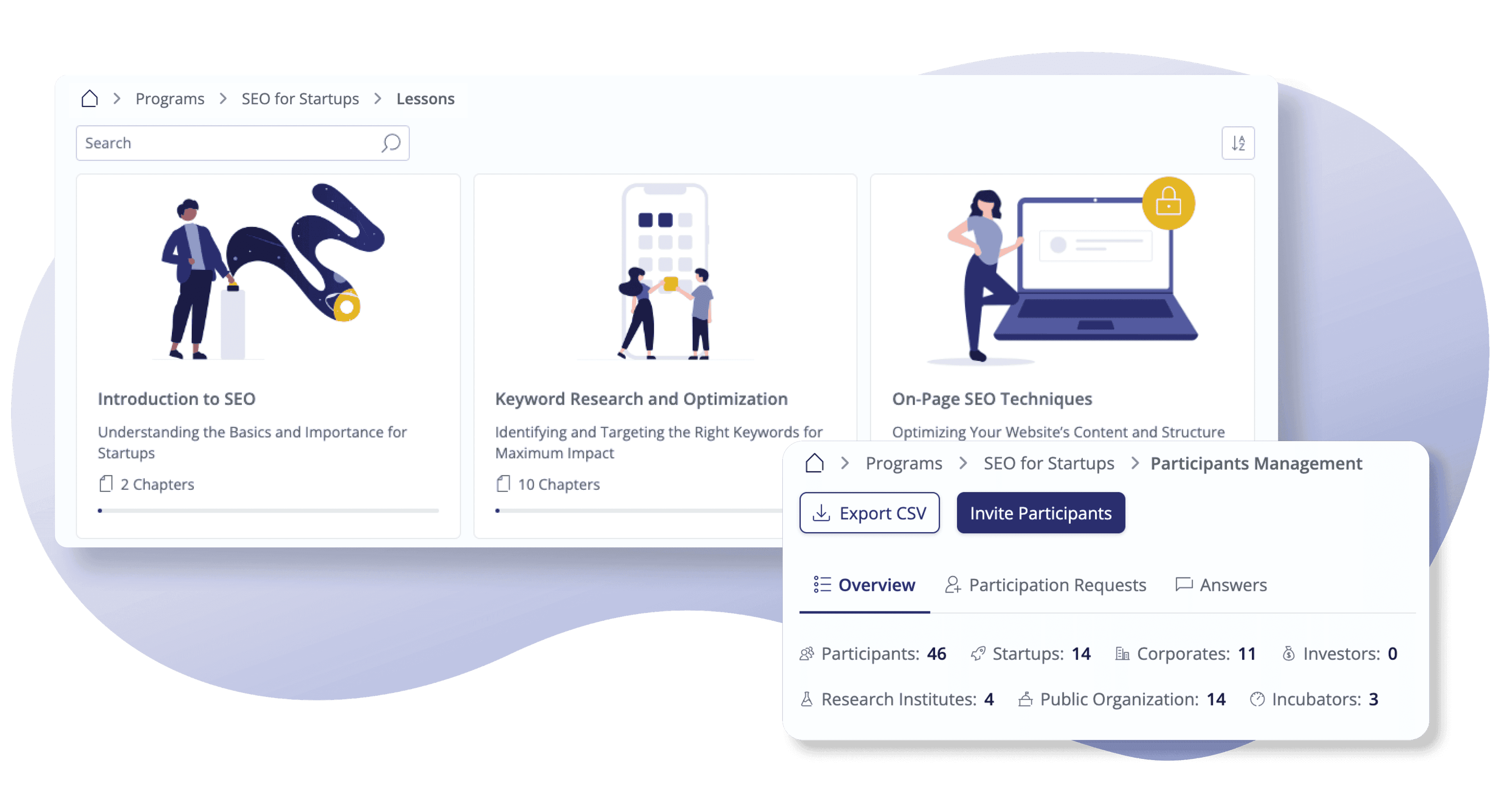
Education, elevated
Craft custom courses that resonate with your startups and turn founders into industry-ready players.
Knowledge, organized
No more scattered resources! Structure your program into easy-to-navigate chapters and build a startup success roadmap so clear, it practically navigates itself
Growth, visualized
Set tasks, track participation, and measure comprehension. Watch your startups grow with insightful learning analytics.
Content planning chaos holding you back?
Host events, organize workshops, send updates, and keep your community buzzing—all in one place.
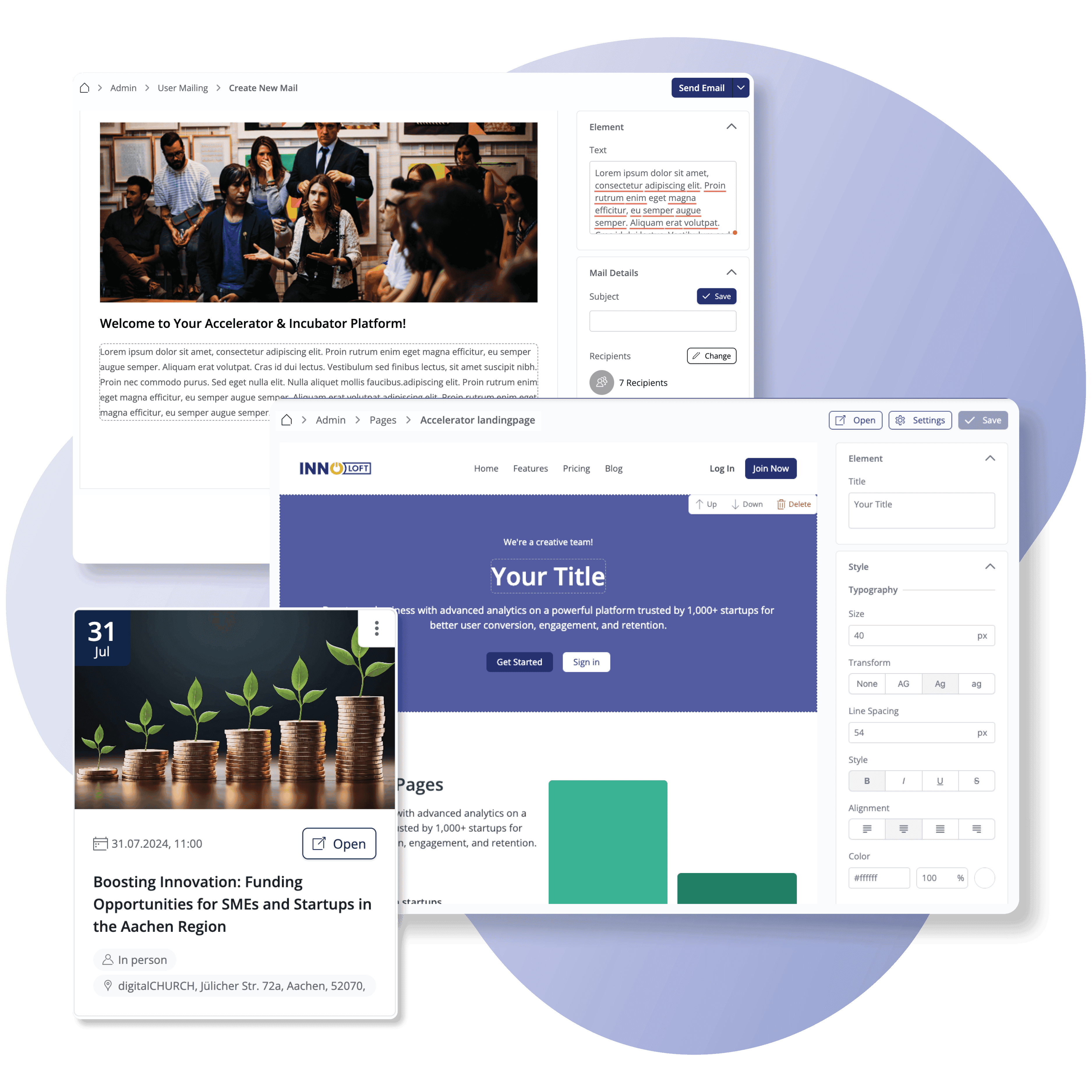
Targeted communication
Forget the communication mess. Nourish your community with personalized newsletters, automated welcome messages and updates they actually want to read.
Dynamic events
Host engaging events and networking sessions with ease. Transform dull networking into can't-miss experiences. From workshops, to speed-dating, we've got you covered.
Curated content
Deliver personalized content on your feed that keeps your community hooked and engaged with highlighted updates that matter most.
Effortless webpages
Craft a stunning website without coding. Become an overnight web design pro and create an attention-grabbing site that attracts founders, coaches and investors alike.
Feel like investors and funding rounds slipping through
the cracks?
Seamlessly connect startups to their perfect investors
and track every funding milestone.
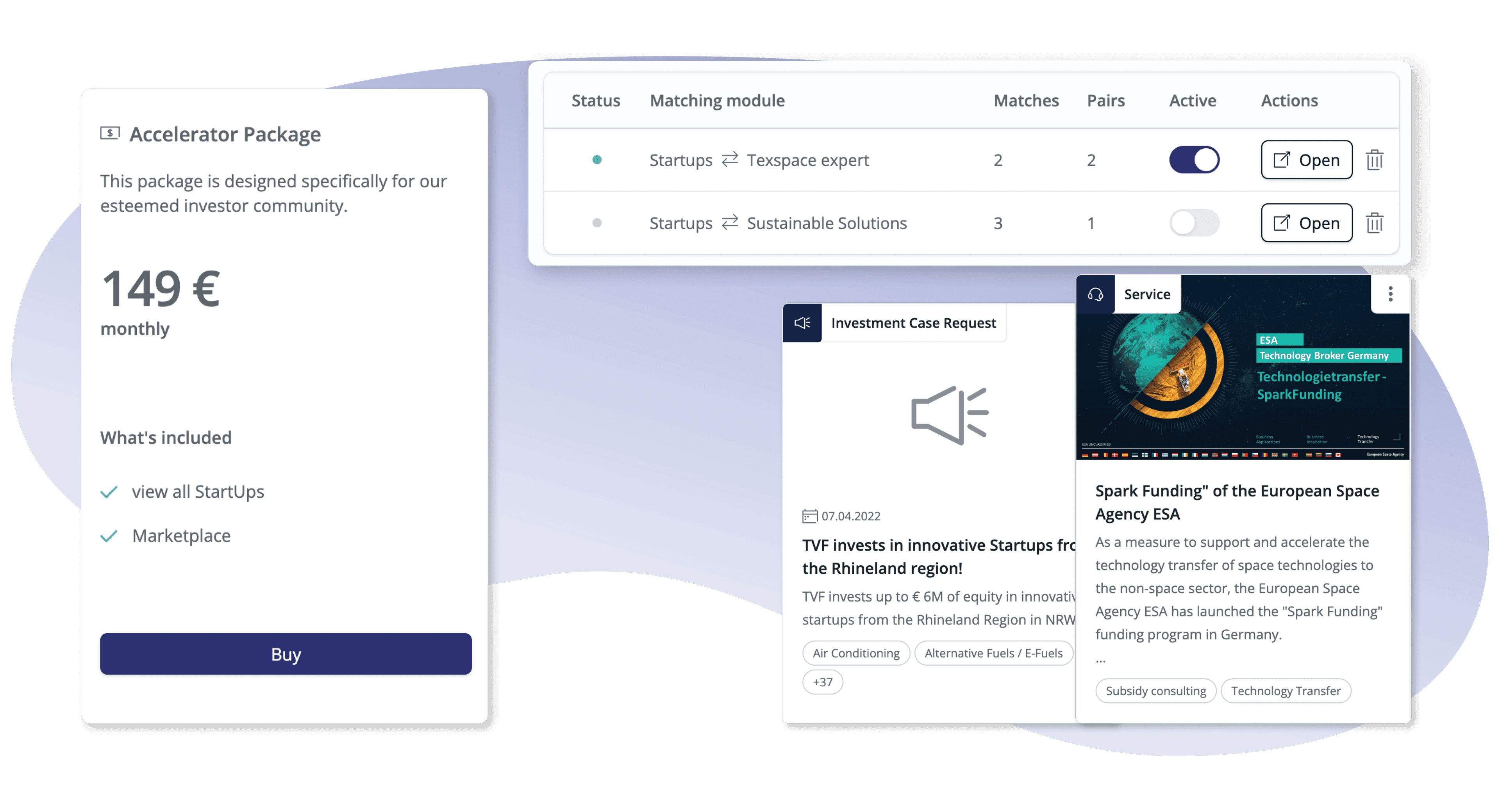
Tailored access
Customize roles and permissions to create an exclusive, secure and efficient ecosystem for your investors.
Perfect matching
Connect startups with their ideal VC firms in seconds. Our matchmaking magic turns networking into an art form.
Opportunity spotlight
Empower members to highlight their needs and offerings with tailored application forms and straightforward offer and request system.
What are you waiting for? Start growing your startup program with a comprehensive accelerator management software
Leverage the advantages
of our no-code platform
Be your own developer
Fast-track your digitalization journey
Cut software development cost by 80% with no-code flexibility
Find more insights related to building a startup accelerator and incubator platform
Best practices
6 Best Community Engagement Strategies (2026 Complete Guide)
If your community engagement strategies feel stale, you’re not alone. Many communities see posts taper off just when growth should snowball. This guide focuses on the tactics that get members posting, replying and showing up – from inclusive live events to data‑backed feedback loops – so you can keep momentum high week after week.Looking for the bigger picture first? Our guide to community strategy covers goals, audiences and positioning, and our guide to a community engagement plan shows how to turn the tactics below into a concrete plan.Quick Answer: What Are the Best Community Engagement Strategies?The most effective community engagement strategies are: (1) anchor the community on one clear promise, (2) build rich member profiles and use matchmaking to connect people, (3) publish targeted content on a fixed rhythm, (4) treat onboarding as an ongoing path, (5) host regular live events, and (6) track a few health metrics and automate routine tasks. Each one gives members a concrete reason to post, reply or show up again – which is what engagement is.Key takeawaysLead with one promise. A clear mission rallies members and keeps community forums on‑topic.Profiles power connection. Rich data shortens match time and fuels targeted content sharing.Keep the drumbeat alive. An events calendar plus automated reminders prevent the “empty room” effect.Measure and reward. Use quick online surveys to spot gaps, then roll out simple reward programs that turn satisfied users into evangelists.What Is Community Engagement?Community engagement is the ongoing flow of interactions—posts, polls, replies, meet-ups—that builds trust and social capital inside your space. Unlike one-way marketing blasts, it opens a live feedback loop on the platforms you already own. Picture this: a member asks for a new reporting filter, ten peers vote it up, and your team ships the feature next sprint. That quick cycle sparks goodwill, prompts more ideas, and pushes long-term community development forward. In short, engagement isn’t algorithms; it’s consistent conversation with a purpose.Online vs. Civic Community EngagementSearch for “community engagement” and many results are about civic engagement: cities, universities and public agencies involving residents in decisions through consultations, workshops and surveys. This guide is about online community engagement: getting the members of a digital community – customers, partners, member companies or a regional innovation ecosystem – to take part on a platform you run.The two overlap more than it seems. Economic development agencies, clusters and associations often do both, for example when a regional portal runs an idea competition with public voting. The core principles carry over – listen first, make taking part easy, close the feedback loop and show what changed – but the channels differ: civic programs lean on town halls and consultations, online communities on profiles, threads, events and matchmaking inside one platform.Why Community Engagement Matters?Strong community engagement turns passive audiences into active problem‑solvers. Teams that invest here see support tickets drop, feature adoption rise, and feedback loops tighten—often in a single quarter.It is the fuel for lasting community development, not a feel‑good add‑on. If you’re still laying the groundwork, our online community guide breaks down the setup; what follows shows why the work pays off.What Are the Benefits of Having a Community? Building a home for your online communities delivers more than chatter. It drives revenue, sharpens your roadmap, and deepens loyalty, all measurable wins. Our best online community apps list proves you don’t need a giant budget to start. There are many benefits of having a community, but here are the top 3 we think are the most crucial. 1. Revenue GrowthA thriving hub moves prospects from interest to purchase without extra ad spend. Members share use cases, answer each other’s questions, and post success stories that act as social proof. When new visitors see peers winning, conversion rates climb.Companies tracking these ties report higher lifetime value and shorter sales cycles. Monetization flows from memberships, premium content, and sponsor spots, income that compounds with each fresh batch of community members.2. Product InsightCommunities are real‑time focus groups. Polls, AMAs, and idea boards reveal pain points before churn hits your metrics. Post quarterly updates in a public portal and tag the contributors who sparked the change; this keeps the feedback loops visible and alive. Over time, features born from member votes enjoy higher adoption because users already feel ownership. This continuous insight cycle means fewer guesswork sprints and a roadmap driven by proven demand.3. Brand LoyaltyConsistent community outreach—welcome threads, behind‑the‑scenes demos, spotlight interviews—builds emotional ties that extend beyond products. Active members defend your brand in wider forums, lowering reputation risk and acquisition costs. They also surface creative solutions that inspire other readers. You can review our curated online community examples to see how social capital translates into long‑term retention and referral growth.Best Community Engagement Strategies1. Focus on One Core PromiseEvery thriving online community shares a single, visible goal, whether it’s faster product tips or peer learning. Hang that promise on your homepage and tie new community projects back to it so momentum never splinters. LoftOS pins the mission inside a public portal, keeping each update in plain sight. For deeper planning, skim our community growth guide.2. Create Rich Member ProfilesPeople connect faster when they see shared interests at a glance. Prompt community members to list skills, needs, and preferred topics so matching happens organically. In LoftOS (our product), profile fields feed smart search and AI matchmaking, which suggests relevant contacts to each member instead of leaving discovery to chance – and every match feeds your feedback loops for future features. innomatch niedersachsen, the platform of the state agency Niedersachsen.next (a LoftOS customer), uses AI matchmaking to introduce founders to co-founders and coaches who fit their idea. See the practical angle in our community management template.3. Publish Targeted Content RegularlySilence is the enemy of participation. Use questions raised in the last week to shape short tip posts, five‑minute case studies, and polls that ask for next‑step advice. A predictable cadence—say every Tuesday and Thursday—trains readers to return, and embedding a simple call for reactions at the end of each post raises reply rates.Keep older gems pinned in a public portal, so latecomers can see the most useful threads first, avoiding the “empty room” effect.4. Keep Onboarding OngoingOnboarding is not an email sequence; it’s a continuous path of small wins. After the welcome message, guide newcomers to introduce themselves, react to a poll, and attend a micro‑event.Monthly refresher digests highlight advanced features and spotlight member successes, reminding long‑time users of tools they may have missed.A well-crafted onboarding experience can increase customer retention by up to 50 %, according to this roundup of onboarding statistics. The same logic applies to communities: onboarding not only raises engagement, it often decides whether a new member stays at all. 5. Host Live EventsLive touchpoints turn usernames into people. Short AMAs, roundtables, or virtual coffee chats give members a reason to log in simultaneously and trade ideas in real time.The event module in LoftOS lets organizers publish an agenda, collect pre-registration questions, sell online and offline tickets and stream directly inside the platform, keeping the dialogue in context. After each session, you can post a summary thread and encourage speakers to spark follow‑up conversations that sustain momentum.6. Track Metrics and Automate TasksPick three numbers that reflect health—active‑to‑lurker ratio, average first‑response time, and referral growth are a solid start—and review them monthly.When a metric lags, run a quick experiment: a new poll format, a themed member spotlight, or a time‑boxed challenge. Automate repetitive actions such as role assignments or weekly digest emails to keep your focus on strategy, not maintenance. Regular metrics reviews close the feedback loops and ensure the community evolves with member needs.What Are Community Engagement Platforms?A community engagement platform is a purpose‑built community platform that lets organizations host discussions, events, and resource hubs in one space.Think of it as the tool kit that turns online communities from scattered threads into structured collaboration. For a step‑by‑step rollout, our community growth guide maps the journey from zero to thriving just for you.Core features to look for:Member directory with rich profiles and smart matchingEvent features for live AMAs, webinars, and meet‑ups without third‑party juggling.Automation workflows that schedule posts, assign roles, and send reminders while you sleep.Analytics tools where you can get an overview of user engagement trends in one click; Public portal to spotlight top threads, so newcomers grasp the value on arrival.Common Challenges When Executing a Community Engagement Strategy1. Low Engagement and Inactive MembersEven well‑planned community engagement strategies sometimes stall when community members lurk instead of post. Surface fresh prompts, tag quiet experts, and celebrate first contributions to restart the conversation.2. Too Little Time and StaffSmall teams often lack hours for daily moderation. A no‑code setup with pre‑built journeys—see how our LoftOS templates launch spaces in a morning—lets one manager handle tasks that once needed three.3. Hard to Deliver Quality ContentContent dries up when creators guess what members need. Short polls and quick wins keep feedback loops flowing so each article, AMA, or update answers a real question, not a hunch.4. Privacy and Data ConcernsData rules tighten yearly, making GDPR compliance non‑negotiable. Choose tools that come with encryption and consent flows in by default.5. Resistance to ChangeSwitching tools or routines can trigger pushback. A highly customizable platform that mirrors familiar layouts—while adding modern perks—eases the leap and shows members their habits still fit.Examples of Community EngagementTactics become real when you see them in context. Here are three concrete programs that communities like yours run regularly, and what they track. For a broader list of concrete activity formats — challenges, AMAs, member spotlights, micro-events — see our shortlist of community engagement activities that consistently move engagement metrics.Idea competitions with public voting – Regional development agencies open a six‑week challenge inside their portal, gather proposals, and let members up‑vote. Winners receive seed grants and mentoring; the campaign gives members a reason to post every week and to invite others to vote.B2B matchmaking events for marketplace members – Or another, more concrete example, organizers release a speed dating session one week before the event. Suppliers and buyers propose 15‑minute slots based on shared tags, then meet in timed video rooms. Follow‑up threads then track which meetings turned into deals over the next quarter.Tech‑transfer showcases at universities – Research labs upload one‑page briefs and two‑minute demo videos, then host live Q&A sessions with industry scouts. Every session ends with a quick survey and a “licensing interest” poll, keeping the knowledge‑transfer loop transparent. How to Measure the Success of Your Community Engagement Efforts?Numbers turn gut feeling into a roadmap. Track how often people speak up, how fast the audience grows, and what feedback loops say about value. With three‑to‑five well‑chosen metrics, you will spot plateaus early and adjust before momentum fades.Engagement RateStart with a simple formula: posts per active member (total posts divided by active members) for a given period. A steady climb signals healthy dialogue, while drops flag lurking. Tools from the best online community apps list can surface this metric in seconds, saving you spreadsheet work.Member Growth & RetentionRaw sign‑ups mean little without stickiness. Compare monthly joins to retention rate—the percentage still active after 90 days. Sudden churn often points to stale content or poor onboarding, both fixable with tighter feedback loops and clearer first‑week wins.Content Interaction QualityCount likes and replies, but weigh comment depth—are members adding insight or just emojis? Track up‑votes, average word count, and solution acceptances. Rising depth boosts conversion rate because richer answers build trust that converts lurkers into contributors.Revenue & Monetization SignalsMeasure direct income—sponsorship fees, paid tiers, affiliate clicks—and indirect lifts such as sales sourced from the community. If you’re exploring revenue streams, our guide on how to monetize your community outlines four models and the KPIs to match each.Operational EfficiencyHealthy communities also free up staff. Track support‑ticket volume, average response time, and hours saved through automated workflows. Real‑time analytics tools and editable data dashboards—like those found in leading community management software—let non‑technical teams spot bottlenecks fast. LoftOS’ flexible dashboards surface the same insights without code, so you act on data, not hunches.Modernize Your Community Engagement Strategy with LoftOSYou now have a complete playbook for community engagement—from one clear promise to day‑to‑day conversations, events and metrics. The only barrier left is tooling that keeps pace with your goals.The flexible LoftOS features suite (LoftOS is our product) lets non‑technical teams launch spaces, run live events, and track results in one place, so plans turn into action the same week. Ready to move from ideas to measurable wins? Explore the platform or, if revenue is next on your list, dive into our guide on how to monetize your community for practical next steps.FAQWhat is a community engagement strategy?A community engagement strategy is a plan for how you get members to take part – which promise the community makes, which formats you run (threads, events, matchmaking, challenges), how often, who owns them and which metrics tell you it works. For the overarching goals and audiences, see our community strategy guide.What are the 7 steps to effective community engagement?A practical sequence: 1) define the one promise your community makes, 2) understand who your members are and what they need, 3) choose a platform that keeps profiles, discussions and events in one place, 4) onboard new members step by step, 5) run a steady rhythm of content and live events, 6) close the feedback loop by showing what changed because of member input, and 7) measure a few health metrics and adjust. Our community engagement plan turns these steps into a template.What are some examples of community engagement strategies?Typical examples are idea competitions with public voting, B2B matchmaking or speed-dating sessions before an event, regular AMAs with experts, member spotlights and onboarding challenges for newcomers. More formats are collected in our list of community engagement activities.How do you measure community engagement?Start with three to five metrics: posts per active member, the share of members still active after 90 days, average first-response time, depth of replies and – where relevant – revenue or support tickets influenced by the community. Our guide to community engagement metrics explains how to track each one.
Success stories
2 Continents, 1 Platform: How StAfrica is Building a Startup Community Across Continents with LoftOS
Meet StAfrica - Startup Germany-AfricaMeet StAfrica Startup Germany-Africa, the startup community that's igniting a new era of economic collaboration between Germany and Africa.Backed by Germany's Federal Ministry of Economic Affairs and Climate Action, StAfrica is on a dual mission: to make Germany irresistible to African startups and to pave the way for German SMEs into Africa.Born three years ago from a glaring disconnect between the two regions, StAfrica has evolved into a bustling economic bridge.So, how did this audacious initiative come to life? We sat down with Materne L. Mateso, a Project Lead at StArfrica, to get the scoop on how LoftOS is fueling this pioneering project.The Catalyst - Awakening Cross-Continental PotentialBefore StAfrica build a startup community, the startup and entrepreneurship dialogue between Germany and Africa had its gaps. Materne and his team saw these not as roadblocks but as areas ripe for innovation and untapped potential.Enter Materne and his team, who saw this not as a roadblock but as untapped potential.Amidst Africa's green transition and other global shifts, they knew it was time to light a fire under this dormant relationship.Backed by key players like the Ministry of Economics and Climate Change and the University of Koblenz, StAfrica set out on its quest: to turn this missing link into a bustling economic highway.The Problem - Can Building a Digital Startup Community Connect Continents?In the fast-paced startup scene, StArfrica envisioned building a digital startup community hub where German and African entrepreneurs could connect, network, learn, and explore each region's startup landscape and business opportunities.Sounds simple, right? Not so fast.They faced a big hurdle — how to seamlessly blend networking with e-learning. And it wasn't just any hurdle; it was like trying to mix oil and water. They needed a one-stop shop that could do it all.So, they turned to Innoloft with a challenge: Could a single platform meet StAfrica's lofty goals, or would they have to go back to the drawing board? And if so, would it fulfill the unique needs of StAfrica's ambitious project?The LoftOS Solution - Building a Startup Community to Bridge Divides and Build Connections When StAfrica needed a stable platform to power their first-of-its-kind German-African Startup community, they found their match in LoftOS.What really clinched the deal were two key features: our 'programs' for e-learning and our 'events' module. These became Materne's daily go-to's, so essential that he joked about losing sleep if they ever went down.StAfrica took it to the next level with our 'programs' feature, enabling them to host e-learning entrepreneurship courses tailored to their unique needs. This also transformed their platform into a hub for online learning, enabling knowledge exchange efficiently and effectively.And when it comes to organizing exchange trips for startups between African countries and Germany, guess what? LoftOS is right there, making it all possible.Materne explained how these cross-country exchanges are organized through the platform:We have visits from African startups coming to Germany and vice versa. It's all coordinated on the platform, from sending out applications to reviewing them. The physical work is there, but it’s now all digitalized entirely.whLet's dive a bit deeper and see how LoftOS is making Materne's work easier.The Result - A Startup Community Where Tech Meets Tangible ImpactLet's get into the numbers. LoftOS's 'programs' feature has become such a cornerstone for StAfrica, accounting for 60% of their platform activities with more than 150 daily users. And let's not forget our 'events' module — it's responsible for facilitating 20% of StAfrica's event-related tasks.As you can already imagine, this has led to a significant increase in the efficiency of Materne's workflows.Materne sees another layer of value in using LoftOS for StAfrica.The startup community has become the first port of call for African startups landing in Germany, and Materne sees LoftOS as more than just a tool; it's a trust-builder. Startups from both Germany and Africa are flocking to the platform, not just to network, but to network effectively.Both sides sign up to the platform, get vetted by the StAfrica team, display projects, share offers, and even industry news. All while our intelligent matchmaking system makes sure that when these companies meet, it's not just a handshake; it's a meaningful connection.On the cost-saving front, Materne and his team are eyeing the next frontier: moving their successful in-person incubator programs online via LoftOS.Why? Two words: cost and reach. These programs have been a hit since 2021, with their second cohort alone pulling in 230 applications, accepting 116, and graduating 17. Imagine turning this success online — digital incubators would mean fewer overheads, broader reach, and a decreased need for on-ground staff.So, what's the big takeaway? LoftOS isn't just a platform; it's the future of meaningful, scalable connections in the startup community world.Why did StAfrica Choose LoftOS?When StAfrica was on the hunt for a platform, what ultimately won them over were two things: communication and cost-efficiency. Materne couldn't say enough about our quick responses. He recalls:Any challenge we ever had, it was easy to talk to them and the communication channels are very open.And it's not just about speed; it's about effectiveness. "If the person you're talking to can't solve your issue, they swiftly communicate your needs to the IT team," Materne adds.But the perks don't stop there. Materne also highlighted how LoftOS has been a cost-saver for them, especially when it comes to training. "Instead of flying someone over for two or three weeks, we can now deliver two weeks' worth of training right on the LoftOS platform. That brings the costs really down and helps a lot on the cost-saving side," he notes.3 Quick-Fire Questions about LoftOS for MaterneQ: What's one LoftOS feature you couldn't live without?Tough to pick just one! But if I had to, I'd say it's a tie between 'programs' and 'events.' The 'programs' feature is a lifesaver for our e-learning courses, and 'events' keeps everything organized. Oh, and let's not forget 'chat groups' for seamless communication.These features are my bread and butter.Q: Any advice for organizations or institutions looking to try LoftOS?If you're a program manager, know that LoftOS is an incredibly flexible tool to build a startup community. LoftOS is all about efficiency too. I can't even imagine going back to the old way of doing things. In short, LoftOS makes your life easy and helps you hit your targets without breaking a sweat.Q: How would you describe LoftOS to someone who's never heard about it before?In one word? Awesome. LoftOS is more than just a platform; it's a flexible tool that adapts to your project's unique needs. It's designed to be intuitive, so you can shape it to fit your goals right out of the box.The StAfrica Experience - Where Vision Meets RealityThe StAfrica story is a testament to what can be achieved when vision, innovation, and the right digital tools come together. It's a tale of breaking down barriers and building bridges — literally and figuratively.If you're a project manager at a research institute, economic development agency or startup program looking to build a community, this could be your story too. LoftOS isn't just a platform; it's a catalyst for change, a tool that can elevate your project from concept to reality, just like it did for StAfrica.LoftOS isn't just a platform; it's a catalyst for change, a tool that can elevate your project from concept to reality, just like it did for StAfrica. Ready to transform your institution's goals into tangible results?Check out our platform templates and start creating yours for free today.
Features
Meet LoftOS's Business Matchmaking System To Connect Smarter
Quick answer: Business matchmaking means connecting companies, experts or members whose needs and offers fit, systematically instead of by chance. In LoftOS you set it up yourself: you decide who is matched with whom, either with your own rules (attribute pairs and weights) or with AI that scores every pair and explains why it fits. Members then see their matches and can message, rate, accept or send requests.Disclosure: LoftOS is our product. This post explains how its matchmaking works. For a vendor comparison, see our overview of B2B matchmaking software.Most networking still leaves too much to chance. Greg McKeown even argued in Harvard Business Review that 99% of networking is a waste of time. Promising partnerships slip through the cracks because the right people never meet.If you run a community, an ecosystem or a member network, you can change that by playing matchmaker: suggest the contacts that matter to each member, based on the criteria that matter to your network. That is what business matchmaking in LoftOS is built for, without coding.Business matchmaking vs. B2B matchmaking vs. event matchmakingThe terms overlap, so here is how we use them on this blog:Business matchmaking (this post): ongoing, platform-based matching of members in your own community or ecosystem, and how to configure such a system.B2B matchmaking: the concept and its business benefits. Read what B2B matchmaking means and how your organization benefits.Event matchmaking: pre-scheduled one-to-one meetings at trade fairs, conferences and matchmaking days. See how to organize a B2B matchmaking event.Choosing a tool: compare B2B matchmaking platforms and their pricing or browse our overview of matchmaking tools.What's new: AI matchmaking with Matching 3.0In October 2026 we released Matching 3.0, a complete rework of how matchmakings are built and how members experience their matches. You choose one of three calculation methods:Algorithm: rule-based matching on attribute pairs you weight yourself, from location to data in other databases.AI scoring: the AI reads both entries in full, follows your instructions and returns a score with a short reason that members see on the match. No attribute mapping needed.AI generation: for every match, the AI proposes a concrete joint project, including the role of each side and why the idea fits.You also decide how members see their matches (in batches over time, all at once or as a swipe deck) and what they can do with them: message, rate with 1 to 5 stars, accept or decline (the platform introduces both sides only when both accept), or send a request. Here is the overview of customizable AI matchmaking in LoftOS.The Flexible Business Matchmaking Foundation: LoftOS Configurability Without ProgrammingTrue networking mastery requires more than just basic filters - it's about making genuine connections that click on a deeper level. That is what LoftOS is built for: a configurable business matchmaking solution tailored to your network.Right out of the box, our modular AI platform comes set up with pre-built modules for common needs like Offers, Requests, Events, and more. But don't stop there - LoftOS allows you to easily build additional custom modules matched to your unique needs and goals. Yes, you set all of this up without programming. Let’s see how that looks. What Powers LoftOS Business Matchmaking?Within each module, you'll find databases for storing specific data types. Not only can you customize these databases with access controls and filters, but you can define your own user types with distinct sections and attributes to capture the data points you need.For example, if you are a program manager running a startup accelerator program you could easily define custom user types like "Mentors", “Founders”, “Investors” or "Rising Stars" with enriched specific section and attributes collecting information that genuinely matter such as:Amount of customers SkillsCredentialsLanguages spokenCertificationsPitch deckIn the backend, platforms admins can decide whether this attribute is a Free-text, Multi-Choice, Linear Scale, File Upload, etc…for capturing nuanced details that lead to meaningful matches down the road.You choose the attributes that matter for your matches.But we don't stop there.LoftOS connects those rich user profiles with fully tailored onboarding journeys. New members, defined by the user types created before, are guided to provide all the right info upfront, setting them up for success from day one. It's a holistic approach to business matchmaking - first understanding your distinct audience segments, then continually enhancing matches as your community's needs evolve.Oh…and that's just scratching the surface of LoftOS's customizability.This flexibility runs through the whole platform. You design the entire networking experience without code, as the next section shows.How LoftOS Matchmaking WorksMatching 3.0 replaces the old four-step flow with a guided wizard: basics, method, presentation, function, pairs or AI instructions, conditions and settings, with tips and examples along the way. New matchmakings start as drafts until you activate them. Whether you pair students with mentors or investors with startups, the setup follows the same logic.Step 1 – Basics: Name the matchmaking and pick the two sides you want to match. For example, if you're building a university innovation platform, you select the "Student" and "Coach" types you defined before. The two sides can be custom modules, organization types or user types.Step 2 – Method, presentation and function: Choose how matches are calculated (algorithm, AI scoring or AI generation), how members see them (batches, all at once or swipe deck) and what they can do with them (message, rate, accept or decline, send a request).Step 3 – Pairs or AI instructions: With the algorithm, you create your match "recipe" by pairing relevant attributes of both sides. Students might have a section "What I'm looking for" with options like coaching, mentorship or co-founders; match that against the coaches' "What I offer" options like leadership training or consulting. With AI scoring, you describe in plain language what a good match looks like instead.Step 4 – Conditions and settings: Add conditions for a valid match, for example local coaches only or students with a specific expertise, and adjust the settings. Then activate the matchmaking and run it.Your matchmaking is now live and connects members with their best-fitting counterparts. If you change the configuration later, the Matches tab shows that scores are outdated and lets you re-run the matchmaking with one click.You Have The Power To Create Anything You Dream of You are not limited to one scenario. You can build your own matching experience from scratch, from investors and entrepreneurs to jobseekers and employers.Think:Real estate agents matching properties to buyersCompanies matched with relevant support consultantsAccommodation seekers paired with ideal room/flatmate optionsBuyers automatically matched to compatible sellersResearch teams matched with industry partners for technology transferOne example from our customers: Business Metropole Ruhr ran the Matchmaker.Ruhr platform on LoftOS, which connected startups from all over the world with industrial partners from the Ruhr area. According to our own data, over 80 web portals have been built with LoftOS, with more than 100,000 users in total.LoftOS also goes a step further by naturally bridging this process to your custom Onboarding journeys.From the moment a new user signs up, you can prompt them to provide all the critical insights that will unlock top level matching - from core traits and preferences down to niche requirements. LoftOS combines intelligent business matchmaking algorithms with human-centered onboarding to ensure your members are paired with ideal counterparts from day one. Matchmaking your way: Handpick Your Matches But what if you want to take networking into your own hands? Beyond smart automated matching capabilities, we empower you to take full control as the master matchmaker. With intuitive overrides, you get to handpick any connections you prefer. Spotted two members who would be a powerful partnership?As platform admin, you can simply boost that suggested match to 100% compatibility with a few clicks. Or if our system surfaces an unwanted lukewarm suggestion, you can hide or bump it down entirely. This granular control means your members only see the most viable introductions.The choice is yours to curate only the most promising pairings for your community.So let's say you've identified a prime consultant for a governmental project opportunity. With handpicked matches, you can directly initiate that connection, overriding the system match to a 100% compatibility rating.Prefer to go totally manual at times? You can also toggle to display only your personal handpicked matches temporarily. It's the perfect blend of automated efficiency and human curation. You remain the networking authority, while our technology simplifies the heavy lifting.Getting Started: Your Roadmap to Better Business MatchmakingBehind every great partnership is a well-engineered journey, getting the right people in the right networking stream. But you're wondering how to actually get started, right?Here's how that journey begins for you:First, head over to our free platform templates and choose the use case that best fits your matchmaking needs. Entrepreneurship hub? Community network? We've got a template to kickstart your growth.From there, you'll define the core modules for your platform and within the attributes that capture your members' must-have details. Then ask yourself, “What are the key traits you need to facilitate networking?” Make those traits your matching data points by building out dedicated sections. Not sure how? Our quickstart guide in the Help Center walks you through the setup. Once that's done, open Matchmaking in the admin area and click "Create matchmaking". The wizard takes it from there.Told you it was simple.But let's be honest, matchmaking is still a complex game. So if you'd rather get professional guidance in making this a success, we've got our experts ready to hop on a call and co-pilot you to success. Book a 30 minute free call with our team, it's matching time!FAQWhat is business matchmaking?Business matchmaking connects companies, experts or members whose needs and offers fit. Instead of hoping the right people meet at random, a matchmaking system suggests relevant contacts based on profile data, rules or AI.How is business matchmaking different from event matchmaking?Event matchmaking schedules one-to-one meetings for a specific trade fair or conference. Business matchmaking on a platform runs continuously: members get new suggestions as the community grows and their profiles change.Does LoftOS matchmaking use AI?Yes. Since Matching 3.0, you can choose between rule-based matching and two AI methods: AI scoring, which rates each pair and explains why it fits, and AI generation, which proposes a joint project for every match.Can platform admins control the matches?Yes. Admins define who is matched with whom, set conditions and can adjust system-generated matches manually, for example by handpicking a pairing or hiding a weak suggestion.What can members do with their matches?Depending on your setup, members can message a match, rate it with 1 to 5 stars, accept or decline it (both sides are introduced only when both accept) or send a request that the other side confirms.
