
Most communities don't fail from a lack of effort. They fail from a lack of meaningful interaction.
If you're struggling to keep people engaged, you're not alone. What you need isn’t more content—it’s better interaction design.
This post gives you 30 battle-tested community engagement activities that actually work in 2026. From icebreakers to rituals to content prompts—each one is built to drive action, trust, and retention.
And if you're still building the foundation? Start with this step-by-step guide to launching a thriving online community.
Quick Answer
Community engagement activities are structured formats designed to bring members together, spark interaction, and build long-term retention. The most effective ones fall into six categories:
- Onboarding — Icebreaker threads, Member Maps, Tag-a-Peer challenges
- Ongoing interaction — Weekly Wins, This-or-That Polls, Teach Me Tuesday
- Feedback & insights — Monthly Pulse Checks, What-Should-We-Cover-Next polls, AMAs
- Recognition — Milestone Spotlights, Peer-Nominated Appreciation Threads
- Re-engagement — Welcome-Back threads, Silent Surveys, Invite-Only Micro Events
- Local & in-person — Neighborhood pop-ups, Listening Sessions, Skill Swaps, Volunteer Days
This guide covers 30 proven activities for online, local and hybrid communities, activity picks by audience, a 7-step planning framework, and the five levels of participation defined by the IAP2 Spectrum of Public Participation.
Definition and Purpose of Community Engagement Activities
Community engagement activities are intentional actions or formats designed to bring members together in meaningful ways. That could mean participating in a poll, showing up to a virtual event, contributing content, or simply responding to a peer’s post.
But here's the real point: engagement isn’t just about activity. It’s about belonging. The goal is to create a space where people don’t just visit—but return, contribute, and advocate.
When planned right, these activities become a flywheel: they build relationships, increase community input, and turn passive members into active ones.
Want a full blueprint? Check out this complete guide to scaling online communities.
The 5 Levels of Community Engagement
Not every activity aims for the same depth of participation. The most widely used framework is the IAP2 Spectrum of Public Participation, which sorts engagement into five levels by how much influence members actually hold over a decision:
- Inform — You share information, members receive it: newsletters, announcements, monthly recaps. Not participation yet, but the foundation everything else sits on.
- Consult — You ask, members answer, you decide: polls, pulse checks, “what should we cover next?” surveys.
- Involve — Member input shapes the work throughout, not just at one checkpoint: working groups, co-created resources, feedback rounds on drafts.
- Collaborate — Members share responsibility for the outcome: community-led events, member moderators, joint project teams.
- Empower — Members hold the decision: budget votes, member-elected councils, open governance.
Most communities operate in the middle three levels. When engagement feels flat, the usual cause is a mismatch — running Inform-level activities while asking for Collaborate-level commitment. Before changing the activities, check the metrics that show which level you are actually at.
Community Engagement Activities at a Glance
Activity type | Best for | Typical effort | Format |
|---|---|---|---|
Icebreaker and introduction threads | Onboarding new members | Low — one post | Online |
Polls and this-or-that questions | Reviving a quiet feed | Low — one post | Online |
Weekly ritual threads | Building a habit loop | Low, but recurring | Online |
Skill-sharing and teaching posts | Peer learning | Medium — needs prompting | Online or hybrid |
Pulse checks and surveys | Gathering member input | Medium — needs analysis | Online |
AMAs with leadership | Trust and transparency | Medium — needs scheduling | Online or hybrid |
Recognition and milestone posts | Retention and morale | Low — one post | Online |
Re-engagement outreach | Reactivating lurkers | Medium — needs member data | Online |
Local pop-ups and listening sessions | Reaching people offline | High — needs a venue | In person |
Volunteer days and community projects | Visible shared impact | High — needs coordination | In person |
30 Proven Community Engagement Activities and Creative Ideas
Now let's jump right into the best ways to engage your members in 2026.
This section is packed with 30 proven, practical activities — grouped by purpose, from online rituals to in-person formats — so you can mix, match, and implement without starting from scratch.
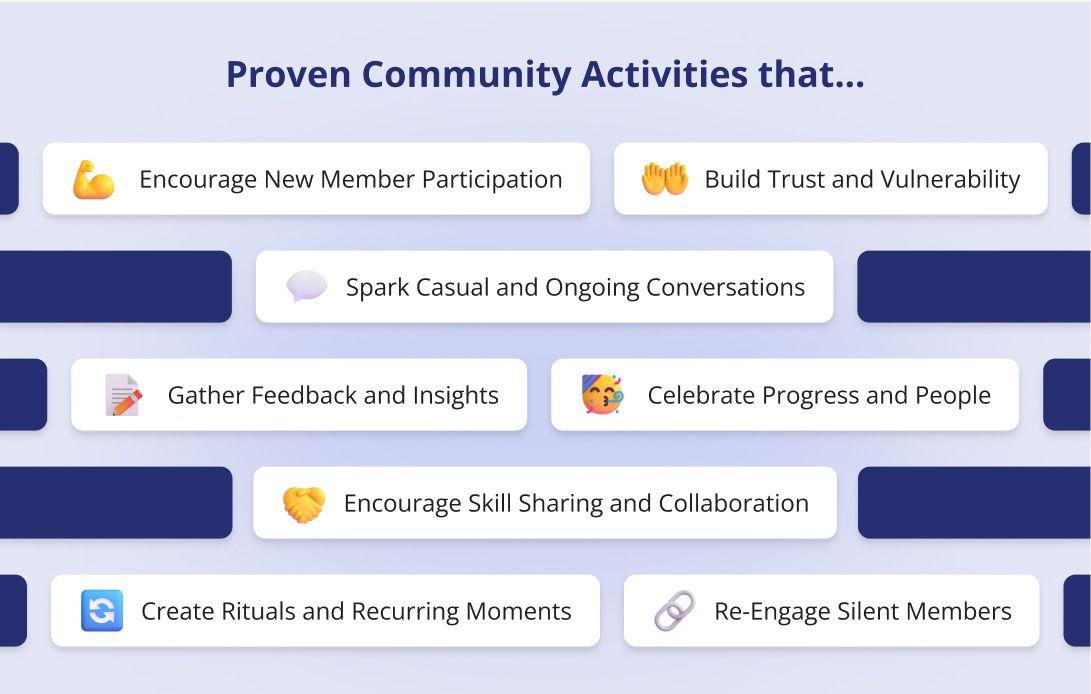
Activities That Encourage New Member Participation
Activity #1: Say Hi Thread With a Twist
Ask newcomers to introduce themselves with an ice-breaker prompt, such as, “Tell us about your role and one tool you can’t live without.” It sets a casual tone while signaling what kind of sharing is encouraged. Ideal for community onboarding.
Activity #2: Member Map
You can use a visual tool to plot members on a map (geographic or thematic). It helps users instantly find common ground and encourages community involvement from the start.
Activity #3: Tag a Peer Challenge
Prompt new users to tag someone they’d like to connect with or collaborate on a virtual event. This creates natural pathways to active participation.
Activities That Spark Casual and Ongoing Conversations
Activity #4: One-Word Wednesday
If you are building a personal or niche community, this a good way to start a lightweight conversation thread: “One word to describe your week?” It lowers the barrier to entry and keeps constructive dialogue flowing.
Activity #5: This or That Polls
Post weekly A/B choices (e.g. “Host a local expo or join an online industry working group?”) via your platform’s online tools. Encourages votes and quick replies, and gathers light public input.
Activity #6: Behind the Scenes: How We Work
Ask members to share how they structure their week or plan their day. Great for sparking relatable tips and maintaining steady community engagement.
Activities That Build Trust and Vulnerability
Activity #7: Lessons from the Field
Create a recurring thread where members share practical lessons learned from real-world experiences. Keeps things reflective yet professional.
Activity #8: What Didn’t Work (and Why)
Invite honest sharing of failed initiatives or past mistakes — but framed as learning. This builds trust and normalizes feedback-based growth.
Activity #9: Story Spotlight
Feature one community member per week who shares their journey or background. Adds depth and human connection to your community engagement process.
Activities That Encourage Skill Sharing and Collaboration
Activity #10: Help Wanted / Help Offered
Create a thread for members to post small asks or offers. Organize them with tags or categories to make it easy to scan and jump in.
Activity #11: Teach Me Tuesday
Members share one quick skill, shortcut, or tip. Bonus: feature top posts in your next community newsletter.
Activity #12: Co-Create a Resource
Use community input to build a crowdsourced guide, checklist, knowledge base or idea bank. It turns small contributions into collective assets and supports action-based learning.
Activities That Gather Feedback and Insights
Activity #13: Monthly Pulse Check
We recommend you to run a quick 3-question check-in every month using online survey platforms, or directly in your LoftOS platform using the Forms module, so everything stays organized and visible..
Ask members how things are going, what’s missing, and what they’d like to see next. In our experience, this keeps community input consistent and digestible.
Activity #14: “What Should We Cover Next?” Poll
Let your members vote on future topics, events, or guest speakers. This simple act of public participation boosts ownership and improves turnout — especially when run consistently.
Activity #15: Ask-Me-Anything (AMA) With Leadership
Invite directors, coordinators, or project leads to host quarterly AMAs. Position it as a transparent community engagement initiative to improve alignment, context, and trust.
Activities That Celebrate Progress and People
Activity #16: Member Milestone Spotlight
Celebrate work anniversaries, project launches, or achievements. Highlighting professional milestones not only boosts morale, but reinforces the value of active participation.
Activity #17: Monthly Contribution Recap
Create a visual post or short list each month of what the community accomplished — new guides, events hosted, helpful threads. It reinforces community engagement efforts.
Activity #18: Peer-Nominated Appreciation Thread
Let members nominate one another for small wins or good deeds. This low-effort habit helps develop a culture of peer recognition and visible gratitude.
Activities That Create Rituals and Recurring Moments
Activity #19: Weekly Wins
A Friday thread asking, “What’s one thing you made progress on this week?” It keeps the tone optimistic and reinforces a sense of collective action.
Activity #20: Monday Prompt (Fresh Question Each Week)
Kick off each week with a relevant, timely question something members can weigh in on without needing prep. Great for keeping your content calendar full.
Activity #21: Event Countdown Thread
In the days leading up to a conference or gathering, post mini-prompts to get members excited. This works especially well in virtual meetings or hybrid formats.
Activity #22: Monthly Learning Roundup
Invite members to share one resource, course, or insight they found valuable that month. It builds an archive of collective knowledge over time.
Activities That Re-Engage Silent Members
Activity #23: Tag-and-Welcome Comeback Thread
Post a friendly open call and tag inactive members (manually or based on data). Frame it as “We missed you — what’s new on your end?”
Activity #24: Silent Survey (for Lurkers Only)
Send a 1-minute survey with questions like: “What keeps you from participating?” or “What would make you return?” Use responses to improve community capacity.
Activity #25: Invite-Only Micro Event or Briefing
Host a small, curated digital or in-person session for quiet members. No pressure — just a chance to reconnect and show that their presence matters.
Activities for Local and In-Person Communities
Activity #26: Neighborhood Pop-Up Table
Set up a table at a market, campus event, or town festival with one visual prompt — a map to pin, a board to vote on, a single open question. People who would never join a call will leave input in 30 seconds. Bring a sign-up sheet so the conversation continues online afterwards.
Activity #27: Listening Session
Invite 8–12 members to a facilitated 60-minute session with three open questions and no agenda beyond listening. Publish what you heard afterwards, including the criticism. This surfaces problems that surveys reliably miss, because people say things out loud that they will not type into a form.
Activity #28: Skill Swap
Members pair up and teach each other one practical skill, 20 minutes each. It works in a room, on a call, or as rotating pairings across a month. Because both sides give and receive, it produces reciprocal relationships rather than one-way consumption.
Activity #29: Community Volunteer Day
Pick one visible, finishable project — a clean-up, a repair session, a build day — and do it together. Shared physical work creates bonds no thread can match, and it gives your community a story worth retelling to the members who missed it.
Activity #30: Open House or Site Visit
Open your space, lab, or workplace for a guided afternoon. Members see how the work actually happens, ask the questions they would not put in writing, and meet the people behind the organization.
Community Engagement Activities by Audience
The same activity — and the same discussion topic — lands very differently depending on who is in the room. Here is what tends to work for the five audiences people ask about most.
For Students
Students respond to activities with a visible outcome and a deadline. Service-learning projects tied to coursework, peer-tutoring swaps, campus listening sessions, and “what should we cover next?” polls all work because participation is short, social, and countable. Keep the commitment under two hours and make the result shareable.
For Youth
Younger participants engage when they have real authority, not a suggestion box. Youth advisory panels with an actual budget line, creative challenges judged by peers, and skill workshops led by slightly older members outperform formal consultation formats. Meet them on the channels they already use rather than asking them to join a new one.
For Adults and Working Professionals
Adults trade attention for usefulness. Peer problem-solving threads, Ask-Me-Anything sessions with people who have actually done the thing, and skill swaps that save time all justify the calendar slot. Recurring, predictable slots beat one-off events — a standing Friday thread outperforms a quarterly webinar.
For Employee and Internal Communities
Inside your own company, engagement competes with real work, so it has to be short and visibly sanctioned. Weekly Wins threads, monthly contribution recaps, volunteer days on paid time, and leadership AMAs work best when a manager takes part in public. Anything that reads as unpaid extra work tends to stall quickly.
For B2B and Member Communities
B2B communities rarely have just one audience. An association serves members, sponsors, and partners at the same time. A customer community serves buyers, prospects, and internal product teams. A regional cluster connects companies, research institutions, and public agencies. Engagement here is less about posting volume and more about brokering the right connections between people who each want something specific.
What tends to work: structured member introductions that state plainly what someone offers and what they need, curated matchmaking rounds instead of open networking, peer benchmarking threads where members compare approaches without publishing numbers, partner spotlights that give members visible commercial value, and small closed working groups built around one shared problem. Whatever the format, the value has to be visible before renewal season — a member who cannot name one useful connection from the past year rarely renews.
Framework for Planning Community Engagement Activities
If you're planning community engagement activities without a clear framework, you're guessing—and guessing rarely leads to lasting engagement.
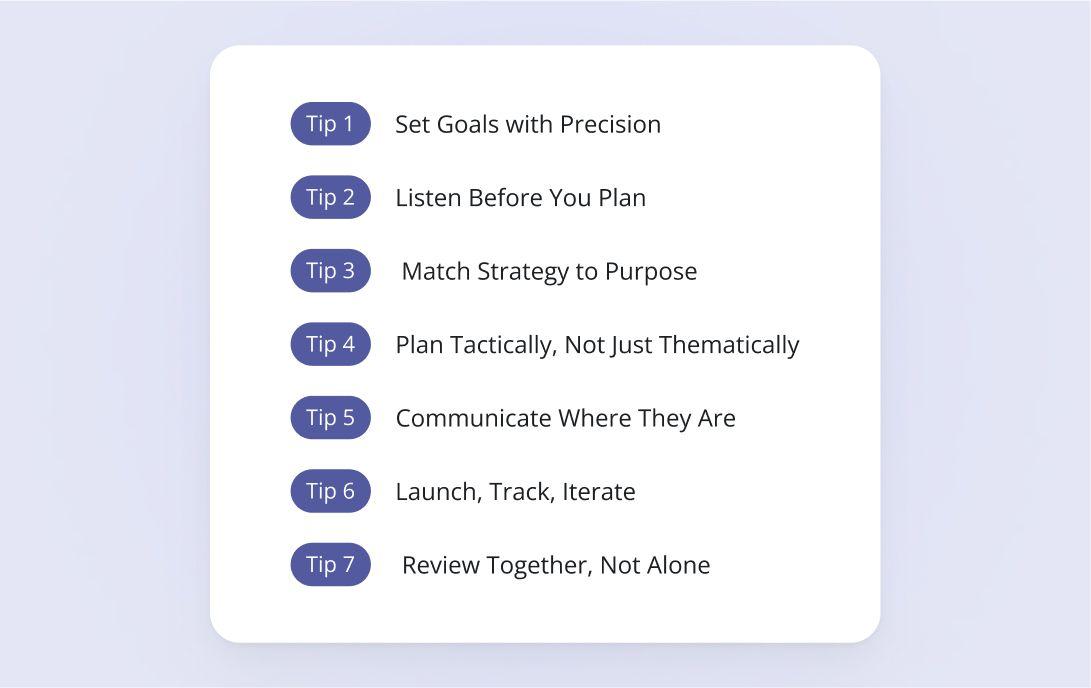
Below is a simple, 7-step system that removes the guesswork and sets you up for real impact.
Tip #1: Set Goals with Precision
Define clear, measurable goals. Are you aiming for better community involvement, feedback, or retention? Use SMART goals and track metrics like click-throughs or community newsletter open rates.
For more on why community goals matter, read these 7 Benefits of Building an Online Community.
Tip #2: Listen Before You Plan
Use feedback tools to gather community input before launching anything. Run a quick poll, host a virtual meeting, or use online survey platforms to uncover what your members care about.
Whatever tool you use, segment the responses by member type before you plan — a request from your ten most active members is not the same signal as one from newcomers.
Tip #3: Match Strategy to Purpose
Don't run a community engagement program just for show. Align each activity to a specific goal, whether it’s nurturing public participation, gathering ideas, or onboarding new members.
Tie every action to a measurable outcome: feedback form completions, content contribution, or increased attendance at virtual events.
Tip #4: Plan Tactically, Not Just Thematically
Ideas are good. Action plans are better. Define the who, what, and when of each engagement effort. Build a content calendar that balances formats: posts, polls, chats, and events.
Need inspiration? Check out these 7 Online Community Examples.
Tip #5: Communicate Where They Are
Don't rely on a single channel. Use multiple communication channels, email, chat, social media platforms, in-platform announcements. And repeat your message more than once.
Schedule messages to specific segments rather than blasting everyone, and space reminders at least three days apart so the second one still gets read.
Tip #6: Launch, Track, Iterate
Every community engagement initiative is a test. Set a go-live date, define what success looks like, and watch how it performs. What’s working? What’s stalling?
Track participation weekly rather than monthly. A ritual thread that loses half its replies by week three needs a different prompt, not more time.
Tip #7: Review Together, Not Alone
Loop in your community leaders, moderators, and community champions to get feedback. Create space for members to reflect on what worked.
The best community engagement strategies are co-built. And they evolve as your community development matures.
Plan with purpose. Track with clarity. And let your community guide what comes next.
Strategic Benefits of Community Engagement Activities
Community engagement isn't just a nice gesture, it's a measurable advantage. When done right, it boosts retention, deepens trust, and gives your brand a real edge.
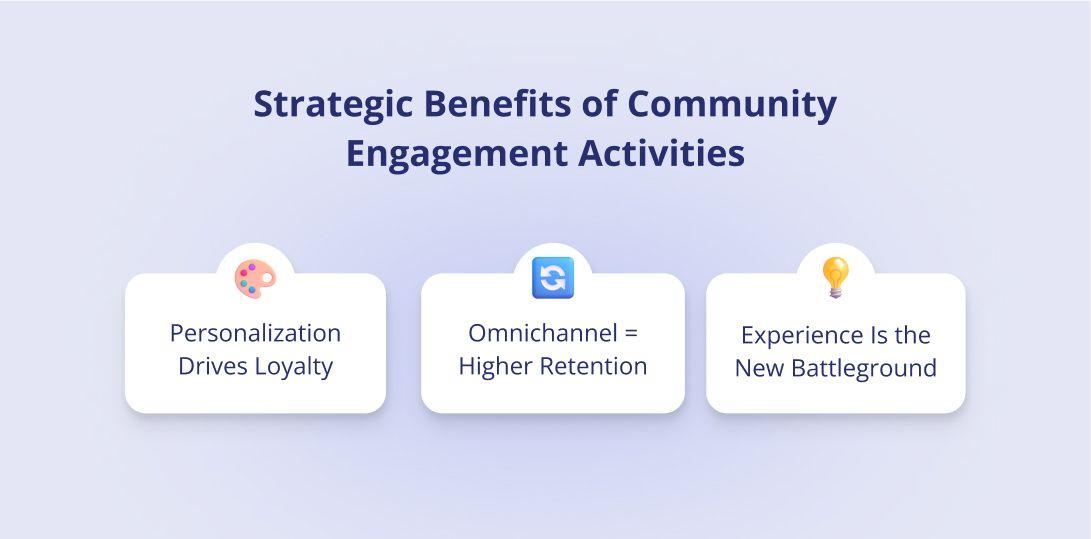
Benefit #1: Personalization Drives Loyalty
Community engagement allows you to tailor experiences based on real user input — from group segmentation to personalized event invites.
And it pays off: 80% of consumers are more likely to stay loyal to brands that offer personalized experiences.
If you’re building a community that fosters real community involvement, explore our benefits guide on building stronger communities.
Benefit #2: Omnichannel = Higher Retention
Engagement tools only work if they show up where your users already are. That’s why omnichannel community presence matters. In fact, 60% of companies that offer omnichannel support report higher customer retention rates
From emails to in-platform chat to events — a well-designed community engagement strategy across communication channels keeps members active and reduces churn.
Benefit #3: Experience Is the New Battleground
By 2026, 88% of service pros are expected to compete primarily on customer experience. Communities enhance that experience — they offer real-time answers, support from peers, recognition, and shared wins.
The entire community engagement process becomes a vehicle for better service and a stronger retention rate. And you can see this in action in these real-life community examples.
Frequently Asked Questions
Community engagement activities are intentional actions or formats — such as polls, icebreaker threads, AMAs, weekly rituals, and virtual events — designed to bring members together and encourage meaningful participation. When planned well, they build trust, increase retention, and turn passive members into active contributors.
For online communities, the most effective activities are lightweight and repeatable: weekly prompt threads (like Monday Prompt or Weekly Wins), This-or-That polls, Monthly Pulse Check surveys, and Teach Me Tuesday posts. These formats have low participation barriers and create consistent engagement rhythms.
Start by defining a clear goal — retention, onboarding, feedback, or re-engagement. Then choose activities that match that goal and build a content calendar balancing posts, polls, events, and rituals. Track participation rates, active users, and event attendance, and iterate monthly based on what performs.
Virtual community engagement activities include online icebreaker threads, This-or-That polls, Ask-Me-Anything (AMA) sessions, Monthly Pulse Check surveys, Teach Me Tuesday posts, and event countdown threads. The activities in this guide are designed for virtual, hybrid, and in-person communities.
Track active users (daily, weekly, monthly), content interaction rates (comments, shares, reactions), event attendance, member retention rate, and Net Promoter Score (NPS). A community platform like LoftOS provides an integrated analytics dashboard to monitor all key engagement metrics in one place.
The most widely used typology is the IAP2 Spectrum of Public Participation, which sorts engagement into five levels by how much influence members hold: inform, consult, involve, collaborate, and empower. Some frameworks split these into six, seven, or eight categories, but the underlying question is always the same — how much say do members actually have?
Common examples include icebreaker and introduction threads, this-or-that polls, monthly pulse-check surveys, Ask-Me-Anything sessions with leadership, milestone recognition posts, skill swaps, neighborhood pop-up tables, listening sessions, volunteer days, and open-house site visits. Online formats take the least effort; in-person formats build the strongest bonds.
Short, countable, and social formats work best: service-learning projects tied to coursework, peer-tutoring swaps, creative challenges judged by peers, and campus or school listening sessions. For youth specifically, give the group real decision-making authority — an advisory panel with a budget line beats a suggestion box every time.
Good topics are ones members already have an opinion about: what they are working on this week, what did not work and why, which tool they would not give up, what the community should cover next, and which milestone deserves recognition. Rotate across four buckets — work in progress, lessons learned, peer recommendations, and community direction — so the feed never feels repetitive.
Innoloft: Your Community Platform
Planning engagement activities is one thing. Managing them week after week is where most teams get stuck.
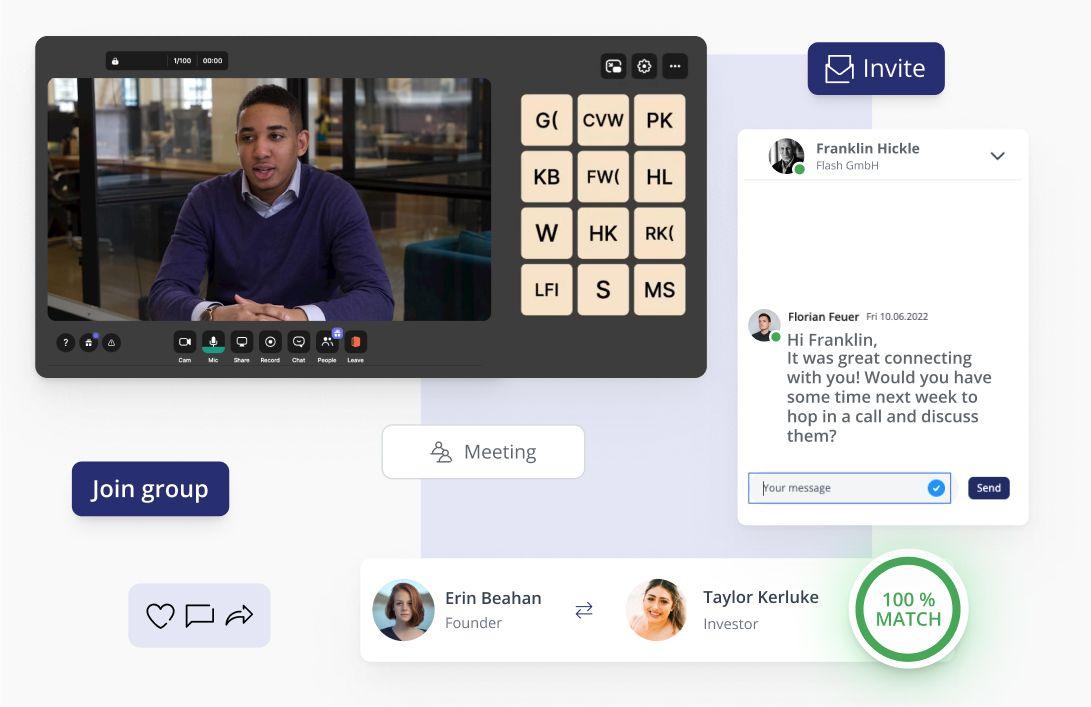
LoftOS helps you keep things moving — with built-in tools for event planning, member management, analytics, and community feedback. Instead of juggling multiple tools or working around legacy systems, you run everything in one place: plan smarter, track engagement, manage feedback, and connect members at scale, without needing to call IT or switch between tools.
“LoftOS is a great community management tool to build a community, to reach out to people and connect them. Don’t try to build your own platform from scratch. Leverage the flexibility of a no-code platform like LoftOS.”
— Kevin Bruns, Digital Transformation Manager, Niedersachsen.next
For a closer look at how these tools work in real-life use cases, here’s a roundup of community management tools that simplify the work.
Want to see what it looks like in action? Explore LoftOS features here or get started with one of our ready-made templates tailored specially to your use case.

Florian Feuer is Co-Founder and CMO of Innoloft, where he leads the marketing and customer success teams. Since launching Innoloft in 2019, he has worked with more than 100 community and platform operators — economic development agencies, tech transfer offices, associations, innovation clusters and corporates — who build their own portals on LoftOS.