Logo
News

Effortless Website Design Without Code: Explore Our Latest 'Pages' Update for Instant, Stunning Sites

Updated on Jul 24, 20257 min read
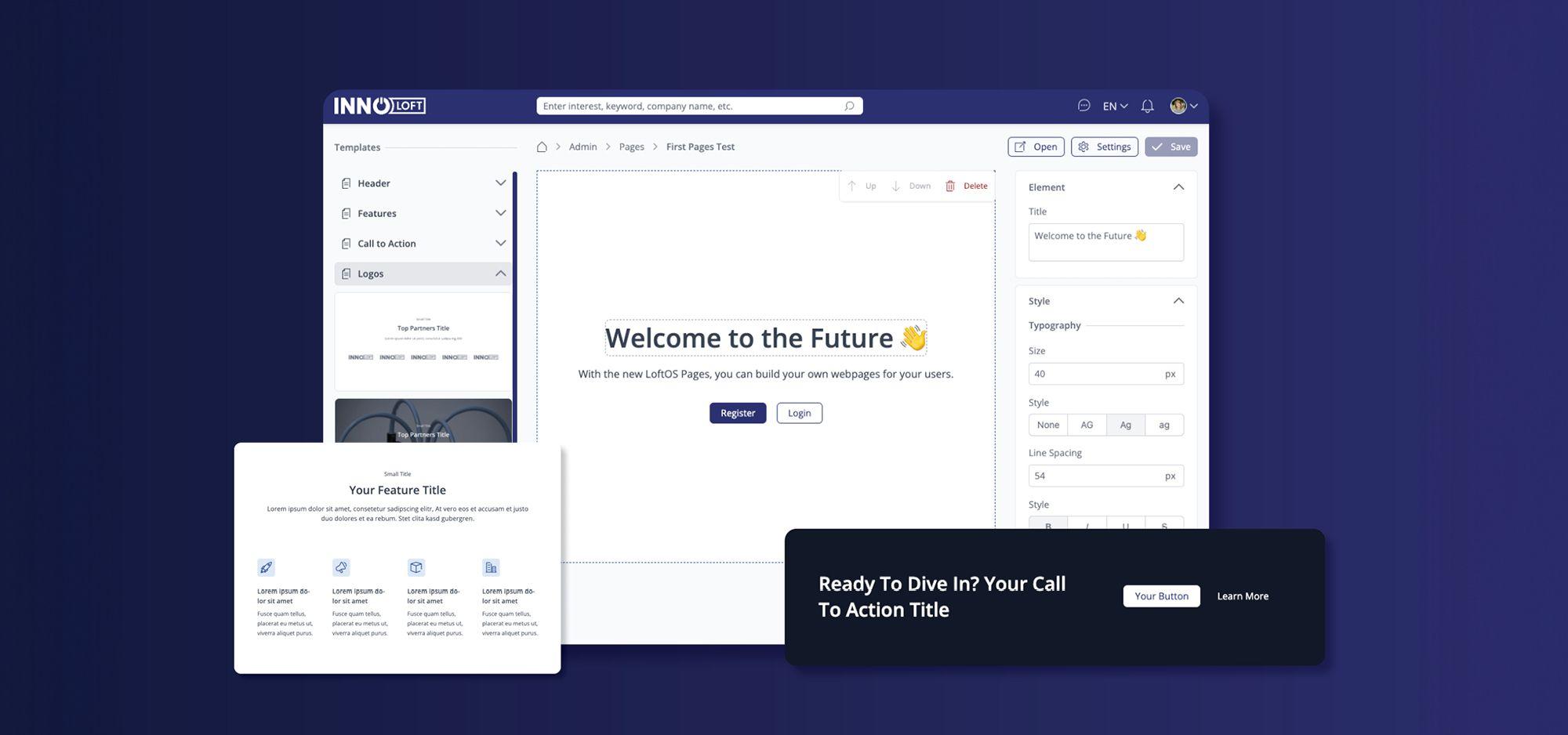
Screenshot of LoftOS' Pages Module, showcasing how easy it is to create websites without writing a single line of code

Unleashing creativity should never be a hassle.

Instead, it should be as easy as envisioning the final product and seeing it come to life, piece by piece.

In the spirit of that vision, we are thrilled to introduce our newest innovation, the 'Pages' module.

Think of 'Pages' as your digital canvas. A place where your ideas take form and your vision materializes.

But it's more than just a creative space—it's a tool designed to empower you to build your own website without code quickly, effortlessly, and in a way that mirrors your brand's uniqueness.

Because, at Innoloft, we believe in providing tools that not just meet your needs, but anticipate them.

Unveiling 'Pages': The Power to Master Web Design Without Code is in Your Hands

The 'Pages' module is all about putting you in control.

It's not just about having a digital footprint — It's about molding an environment that genuinely mirrors your brand and connects with your audience.

'Pages' turns your LoftOS experience into an expansive, custom, and dynamic digital space. It enables you to create any type of webpage you envision without a single line of code.

Be it a comprehensive product description page, a visually appealing homepage for your bustling B2B community portal, or an engaging educational resource, 'Pages' is your key to unlocking diverse opportunities.

Tailoring 'Pages' to Fit Your Industry Needs

In every field, there are unique challenges and specific needs when it comes to digital communication and presence. Your new no-code website builder 'Pages' is designed to adapt to these distinctive requirements, providing a versatile solution regardless of your industry.

Let's explore how 'Pages' can be tailored to some key sectors and their specific use-cases.

Educational and Research Institutions

If you're an admin in a university or research institution, 'Pages' is your tool for effective communication.

Share resources with students or showcase groundbreaking studies to the global academic community. Craft interactive and informative pages packed with crucial information, detailed reports, and engaging visual aids, all styled to align with your institution's branding.

Community Management

As a community manager in a B2B company gearing up for a webinar, 'Pages' provides the power to design unique event pages without code.

Embed event details, speaker bios, and cultivate a sense of anticipation. You can even link out to external registration forms if needed. Foster excitement and enhance user experience, all within your control.

Economic Development Organizations

Public development offices or economic development organizations can benefit from 'Pages' to share crucial economic updates and policy changes.

Craft clear, easy-to-navigate webpages packed with essential information. Keep the public and specific businesses well-informed and up-to-date.

Corporate Innovation Management

In corporate innovation management, when preparing to launch a new product or service, 'Pages' is your ally.

Design sleek, dedicated pages complete with crisp product images, detailed descriptions, and clear call-to-actions. Stay in the driver's seat of your digital projects, keeping up with the fast-paced corporate world.

Pages: The No-Code Website Builder You've Been Waiting For

You asked for more code-free web development tools. We delivered.

'Pages' was designed with your needs in mind.

We've built 'Pages' as a tool that grows and evolves with you.

We've seen our customers use LoftOS for an array of use cases, not just for community management, but also for building entire web solutions, from business sites to a full-featured community website builder tailored to their audience’s needs.

We've heard your calls for more flexibility and greater control over your digital projects, and we've responded.

From creating personalized landing pages for your LoftOS Events, Programs, and Groups, to designing webpages tailored to your specific business needs, 'Pages' puts the power of custom codeless website building right at your fingertips.

As your business expands and your needs change, 'Pages' will be there every step of the way, providing you with the flexibility to adapt and thrive in the dynamic digital landscape.

Web Building Without Coding: Fast, Simple, Efficient

We didn't just create another product update.

We delivered a solution that empowers you to create, manage, and scale your web presence, all within LoftOS.

Our goal with 'Pages' was to make it straightforward for even new users to create professional-looking websites with ease.

With a few clicks, you can customize page layouts, and add new sections such as images, video, logos, headers, and text fields.

Let’s look at what you can do with ‘Pages’.

Transform Your Web Building Process with 'Pages'

In a world where your digital presence often serves as an introduction, being able to craft and tailor that first impression is vital.

You need a website builder that's intuitive, versatile, and adaptable.

With 'Pages', you're not just creating a webpage—you're crafting an experience. By offering a variety of customization options, 'Pages' lets you build not just visually pleasing, but also with functionality at the forefront.

Here's Why 'Pages' Matters:

Customer Independence: 

No more waiting for tech teams to make minor changes to your webpage.

With 'Pages', you're in the driver's seat. Update your pages whenever you want, however you want.

Versatility:

'Pages' offers a wide range of customization options.

From headers and feature sections to call-to-actions, you're only limited by your imagination.

Adaptability:

Want to hide your platform header for a more website-like browsing experience? 'Pages' lets you do that. Need to add a new navigation entry? It's just a few clicks away with 'Pages'.

Personalization:

With 'Pages', each webpage you build can be as unique as your business. Add logos, images, videos, and more to truly make each page your own.

Building Your Webpage Without Coding: A Quick Step-by-step Guide

Let's dive into how you can take full advantage of 'Pages' to create, manage, and customize your landing pages and more.

Step 1: Find Pages

First, head over to 'Admin' in your platform, click on 'Content management', and then 'Pages' to get started.

From there, click the "Create Page" button at the top right corner and then we can get started.

Step 2: Getting Started

Upon creating your new page, you'll be requested to input a page name, an optional page description and a URL path. Once you are ready click on 'Create Page'.

You'll then be presented with a blank page. Here's where the fun begins!

Step 3: Customize Your Page Design

On the left side, you'll see various templates you can choose from, as well as additional customization options.

Such as page layout, and sections with different content types such as text, logos, call-to-action buttons, images, or videos.

On the right side, you can see the edit area where you can modify and customize each section in the page to your liking. The choice is yours.

Step 4: Publish Your Page

Once you are done customizing your page, go ahead and click on 'Save' at the top right corner of the page. You're now just a few clicks away from having a fully functional webpage up and running that reflects your brand and connects with your audience.

You easily see how visitors would look at your page by clicking on the 'Open' button. You're good to go!

Harnessing the power of 'Pages' is as easy as following these steps. Now, you're not just a part of the digital transformation—you're driving it.

FAQs: All You Need to Know about 'Pages':

At Innoloft, we believe that clear and concise communication is key to customer satisfaction. So, let's address some of the most frequently asked questions about our new 'Pages' module.

Q1: What is 'Pages'?

'Pages' is our new module that allows you to build your own webpages without code within minutes. It comes with templates for different sections like headers, features, call-to-actions, and more, which you can directly choose and modify according to your needs.

Q2: How can I access 'Pages'?

You can access 'Pages' right from your LoftOS dashboard. You can find 'Pages' right under 'Content management' in the admin section.

Q3: Is Pages free to use?

Yes, want everyone to be able to design a website without coding. So,'Pages' is included in all our plans, even the free one. However, please note that the free and starter plans feature LoftOS co-branding. If you need custom sections, those are available with our Premium and Custom plans.

Q4: Can I customize the navigation path for my page?

Absolutely, you can! When you create a new page, 'Pages' automatically generates a page path (URL) based on the given page name.

However, you're not stuck with this initial path. You're free to edit it as you wish.

Just remember, only regular letters, numbers, and hyphens are valid characters for the URL. This feature ensures your pages can have URLs that are both meaningful and search-engine friendly.

Your Next Steps to Codeless Web Building Mastery

There you have it. With 'Pages', you're crafting unique digital experiences that truly represent your brand.

This powerful update amplifies the power of no-code, to connect with your audience effectively.

Now, it's your turn to experience 'Pages'. If you're already a LoftOS user, dive right in and start exploring. If you're new here, start building your web presence with 'Pages' today — Create your own LoftOS platform for free now.

Either way, the journey to mastering web building without code starts with a single step. Are you ready to take it?

Share article

Related posts

Article image 8 Best Accelerator Software to Manage Your Startup Program in 2026

8 Best Accelerator Software to Manage Your Startup Program in 2026

Choosing the right accelerator software decides how well you recruit, run cohorts, and report impact. This guide cuts noise fast, compares the top tools, and shows where LoftOS fits. Expect clear criteria, simple pricing notes, and real use cases, so you can pick a platform that runs applications, mentors, and outcomes without duct tape.Key takeawaysThe best accelerator software should centralize applications, reviews, mentoring, events, and reporting in one place, reducing manual handoffs and errors.Prioritize User Experience for admins and founders, or adoption dies. Look for clean setup, role-based access, and configurable workflows you can change mid‑cohort.Insist on Impact Measurement you can trust: track goals, meetings, deals, and outcomes with exportable evidence for sponsors and boards.Choose platforms that play well with your stack: SSO, CRM and data exports, plus guardrails for compliance and privacy. LoftOS leads when you need one platform for programs, community, and matchmaking.1. LoftOS: Best Accelerator Management SoftwareLoftOS helps you run the whole program in one place, so you stop firefighting across forms, inboxes, and spreadsheets. It is practical accelerator software built for admins, not just another portal for founders.Think about it, if a mentor cancels, a judge needs a new rubric, or a partner asks for a different data cut, you should not rebuild your process. With LoftOS, you adjust application workflows, swap scoring forms, move startups across stages, and keep an auditable trail. Your team spends time with people, not patching tools.What you get in practice Intake moves to triage. Reviews run on structured scoring. Matches create real meetings. Events take tickets and check ins without chaos. After demo day, you still have real time progress tracking and Impact Measurement for sponsors and boards.Same workspace, fewer handoffs, less risk.Key featuresApplication Management with kanban style pipelines for application processes and flexible application workflowsReviews and scoring with structured forms, file collection, and an auditable trailCustomizable content databases to track startups, mentors, sessions, tasks, and outcomesFlexible organization and member directories with roles, tags, and permissionsEvent organization with ticketing, sessions, check in, and attendance trackingHigh speed networking and mentor matchmaking for relevant meetings, fasterReal time progress tracking across cohorts and stakeholdersDocument Management for submissions, contracts, and reportsSSO, role management, and membership tiers for secure access and simple governancePricingRunning an accelerator program means balancing growth, structure, and cost. You need reliable software that doesn’t eat your entire budget but still scales as your cohort and stakeholder network grow. LoftOS offers a clear pricing model designed for flexibility,  so you can start lean and expand confidently as your program matures.LoftOS Pricing TiersFree: Up to 5 users, explore features and test-fit with zero risk.Starter $29/mo: 25 users, email support, ticket & helpdesk access.Team $349/mo: 250 users, CSM‑led onboarding, custom domain.Professional $849/mo : 1,000 users, analytics, exports, roles and packages.Enterprise (Pricing on request): 5,000 users, full white‑label setup, on‑site success services.Whether you’re testing your first accelerator cohort or managing a network of programs, LoftOS keeps pricing transparent and growth manageable,  giving you enterprise capability without enterprise complexity.Where it shinesLoftOS reduces admin load by unifying program operations, community, and events in one place, so your team sets up faster and spends more time with founders.Reusable blocks and templates speed up setup between cohortsClean admin User Experience helps non technical teams work confidentlyEvent ticketing and on site check in streamline logistics for large audiencesNetworking and mentor matching drive higher quality meetings and outcomesImpact evidence is export ready for sponsors and boardsWhere it falls shortLoftOS focuses on program operations, not deep coursework or complex financial workflows. In some cases, you may pair it with specialized tools.Not a full learning management system for advanced curriculaLarge grant disbursement flows may require a dedicated finance toolVersatile feature set may involve a short learning curve for first time adminsCustomer reviews“The flexibility and adaptability of the platform. The quick response rate of our CSM [sensitive content hidden]. The fact that we can build our own modules and programmes and now even our own category trees. ” - Capterra Review“I love the possibility of easy customization and openness of features to adapt to your dedicated use case. The company cares about its customers and listen to their new ideas or requirements to implement in the future. If there is any bug, the team is fast to repair it. ” - Capterra ReviewWho LoftOS is best forLoftOS fits organizations that run multiple cohorts or year round communities and want a single platform to manage applications, mentoring, events, and outcomes with clarity.Public sector programs, universities, and associations with many stakeholdersEnterprise innovation teams and corporate venture units running portfolio style programsEcosystem builders that need event management, networking, and measurable impact2. Babele — Best for curriculum‑led accelerators and incubatorsBabele focuses on learning, mentorship, and community wrapped around applications and reviews. It helps program teams guide founders through structured tutorials and assignments while keeping mentors engaged and accountable. Use it when curriculum and knowledge sharing sit at the center of the program, with community updates in one place.Key featuresApplication funnel: Multi‑round selection with reviewer scoring for accelerator applicationsLearning management: Tutorials, assignments, and templates for a guided path, aligned to a Learning management systemMentor matching: Pair experts to specific requests and challenges, track sessionsCommunity hub: Updates, posts, and discussions to keep participants informedRepository: Startup CRM with profiles, notes, and document managementProgress tracking: KPIs and activity logs across venturesPricingPlan names not published. Sales‑led pricing via demo request. Vendor claims fast setup within one day.Where Babele shinesCurriculum first: Strong for programs that require tutorials, tasks, and checklistsMentor alignment: Match experts to tagged needs and track outcomesCommunity engagement: Centralize updates and conversations to reduce email chaosWhere Babele falls shortComplex reviews: Depth of multi‑stage rubrics and mid‑cycle edits may be limitedEvents at scale: Ticketing and on‑site check in are not prominentCustomer reviews“It is visual and engaging. It is a well-designed piece of software which guides you well and provides a good foundation for engaging others. From another perspective, e.g. as an online mentor, it is an accessible way to access some of the data you need to be able to support people, the tool having helped them prioritise.” – Capterra Reviews"We used it with our Social Enterprise module and an international competititon (UKISIC)" – Capterra ReviewsWho Babele is best forPrograms that want structured learning plus community with built‑in mentoring.University incubators: Course‑like cohorts with templates and deliverablesImpact hubs and NGOs: Knowledge sharing with experts across regionsCorporate intrapreneurship: Playbooks for employee challenges3. Skipso — Best for enterprise innovation and open callsSkipso manages open calls, grants, and idea pipelines across large stakeholder networks. It brings sourcing, judging, collaboration, and ecosystem directories into one workspace. Choose it when you need controlled submissions, partner portals, and reporting that follow initiatives from idea to impact.Key featuresOpen calls: Configurable submissions and judging for challenges and grants within open innovation programsPipelines: Track ideas and projects through standardized application processesStakeholder portals: Spaces for judges, mentors, partners, and teamsEcosystem module: Centralize people, content, and collaboration across networksMeasurement: Track progress and outcomes for sponsors with impact measurementPricingSkipso offers structured plans tailored for accelerators, incubators, and innovation programs looking to manage applications, evaluation, and collaboration. Each tier scales in capacity and customization, supporting everything from early-stage cohorts to multi-tenant enterprise environments. Essential: Supports up to 1,000 submissions per program, 1 program per year, and unlimited admin and judge users. Includes form builder, scorecards, live portfolio directory, Kanban pipeline, and task tracker.Enhanced: Expands to 5,000 submissions, 1–2 programs per year, and adds one custom user type. Comes with payments integration (Stripe), team collaboration tools, and extended tracking features.Enterprise: Designed for large networks managing multiple programs. Offers unlimited submissions, advanced scoring flows, multi-tenant environments, and full assignable user types.Pricing is demo‑gated. Exact numbers are only available upon request through a demo call.Where Skipso shinesScale and governance: Built for corporates, public sector, and national programsProcess control: Structured submissions and reviews across multiple initiativesPartner networks: Portals to coordinate external collaborators and [business development]Where Skipso falls shortAccelerator rhythm: Mentor booking and cohort routines may require workaroundsEvents: Ticketing and on‑site flows are not clearly positionedCustomer reviews“Lots of custom support from the team, allowing us to build a B2B innovation matching system for our SME customers. Lightweight interface and as-a-service provisioning make this relatively easy to manage even within the context of large, cumbersome IT departments such as ours.” – Capterra Reviews‘Skipso's customer service is out of this world. The platform has more features and functionality than we have been able to utilize yet, but our pilot program has been a huge success. The ability to customize features and privacy levels has been essential given our unique audience.’ – Capterra ReviewsWho Skipso is best forOrganizations running complex innovation portfolios and public challenges.Government agencies: Grant programs and national challengesEnterprises: Cross‑department innovation with partner involvementIndustry networks: Multi‑stakeholder ecosystems that need governance4. AcceleratorApp — Best for classic accelerator operations with strong schedulingAcceleratorApp consolidates applications, reviews, mentoring, tasks, and communications into one tool. It emphasizes scheduling, deliverable tracking, and multilingual support. Use it if you want a straightforward cockpit from intake to demo day without stitching together several apps.Key featuresApplications: Customizable rounds for application management and structured reviewsScheduling: Mentor and expert booking with calendar syncs, improves user experienceTasks and deliverables: Smart task lists tied to startups, reduces follow‑upsCommunication visibility: Track emails and keep conversations in contextMultilingual: Interfaces for global cohorts, useful for cross‑border programsWorkflow control: Edit [application workflows] as programs evolvePricingAcceleratorApp is designed specifically for accelerators and incubators, offering scalable plans that fit programs of any size. From early-stage initiatives to large innovation hubs, the platform includes application tracking, program management, and participant support.Starter – Best for small organizations managing a few startups; includes up to 100 applications, 12 startups, and 2 programs.Starter+ – Ideal for scaling accelerators; supports unlimited applications, 46 startups, 5 programs, plus onboarding and monthly support hours.Essential – Built for medium-sized programs running multiple cohorts; includes unlimited startups, programs, and added support time.Premium – Adds white-label URL, custom landing pages, and more onboarding and support hours for growing accelerator portfolios.Enterprise – Designed for large networks; includes SLA guarantee, 99.5% uptime, and extended onboarding and success hours.All pricing plans are visible through booking a sales call. Where AcceleratorApp shinesScheduling muscle: Built‑in mentor booking and session managementOperational clarity: Tasks and centralized comms reduce manual trackingGlobal readiness: Multilingual UI for international cohortsWhere AcceleratorApp falls shortEvents detail: Ticketing and on‑site check in specifics are limitedDepth of LMS: Learning module exists, depth should be validated before adoptingWho AcceleratorApp is best forTeams that want a purpose‑built control room for day‑to‑day accelerator ops.Regional accelerators: Repeatable intakes and mentor programsUniversity programs: Structured coaching with scheduling needsCorporate incubators: Clear tasks and deliverables across startups5. Submittable — Best for grant programs and public-sector open callsSubmittable focuses on end‑to‑end grant lifecycle management. It combines a flexible form builder, multi‑stage routing, identity checks, budget tracking, and post‑award monitoring. Programs get structure, compliance, and an audit trail without spreadsheets. If your accelerator is grant‑heavy or works with agencies and foundations, this platform covers intake, review, and oversight reliably.Key featuresForm builder: Create complex eligibility and branching for application processesReviews: Multi‑round scoring and automated routing that reduce manual reviewsCompliance: Identity verification and audit logs for oversight needsPost‑award: Milestone tracking, payments oversight, and reportingBudgets: Real‑time views with exports for stakeholders and Impact MeasurementRecords: Centralized files and notes for strong Document ManagementPricingSales‑led. Public plan names are not listed; teams typically scope features by use case and volume before receiving a quote.Where Submittable shinesSubmittable brings control to complex, regulated programs.Lifecycle depth: From intake to award and reporting, with governanceReviewer scale: Handles large volumes and multi‑stage evaluationBudget clarity: Built‑in financial oversight for sponsors and auditorsWhere Submittable falls shortIt is optimized for grants, not classic accelerator cadence.Mentoring & networking: Limited tools for matchmaking and sessionsEvents: Ticketing and on‑site check‑in are not core workflowsCustomer reviews‘“This allowed me (one of the main users) to be confident in adding to the application or modifying it (e.g., after the deadline passed, reopening it or create a new form to send applicants in the Submitable system to collect additional information from them).“  – Capterra reviews“Submittable's application forms are very customizable and they allow for a multi-step application process and submitting grant reports.“  – Capterra reviewsWho Submittable is best forGovernment and foundations: Compliance‑driven grant programsUniversities & NGOs: Scholarship and award cycles with oversightCorporate CSR: Large‑scale giving with reporting needs6. Untap — Best for competitions, awards, and hackathonsUntap streamlines contests with multi‑round submissions, judge assignments, reminders, and leaderboards. It is quick to launch and clear to administer, with visible plan limits and role controls. If your program centers on challenges, awards, or short sprints, Untap handles logistics cleanly from call‑for‑entries to final rankings.Key featuresTracks and rounds: Configure multiple paths for accelerator applications and evaluationsJudging: And publish rankings for pitch competitionsDashboards: See status, send reminders, and manage partial entriesCloning: Duplicate programs to reuse settings across cyclesExports: Get submissions and scores out for analysis and product development follow‑upPricingUntap offers structured pricing built around support levels rather than feature or submission limits. All plans include unlimited submissions, programs, participants, judges, and admins, as well as full access to every software feature.Starter $250/month: The self-service entry tier. Includes unlimited programs and participants, the full software feature set, multilingual support, email support, and one training session per month.Growth $900/month: Adds hands-on launch support — one setup session per month where the Untap team helps configure your program from scratch, one custom design per month, and three training sessions per month, plus pre-launch and mid-program sanity checks.Ultimate $2,500/month: Designed for organizations running multiple major programs simultaneously. Includes three setup sessions and three custom designs per month, custom domains, priority email and phone support, a dedicated account manager, and quarterly business reviews.Enterprise (pricing on request): Adds full white-label capability, custom SLA agreements, API access, SSO, advanced security features, and unlimited setup, design, and training sessions with a dedicated implementation and technical team.Untap's pricing helps accelerators manage applications, streamline judging, and engage mentors effectively, with predictable costs that scale alongside program growth.Where Untap shinesBuilt for challenge formats.Speed to launch: Templates and cloning minimize setup timeJudging at scale: Simple assignment and scoring for many reviewersOperational clarity: Clear limits and dashboards keep work organizedWhere Untap falls shortIt is contest‑first rather than full accelerator ops.Mentor workflows: Limited support for long‑form mentoring and coachingEvents & community: Ticketing and year‑round engagement need separate toolsCustomer reviews“1. Communication was very smooth. 2. There was no breakdown throughout the time we have used the platform. 3. Easy and user friendly interface. 4. The team is super responsive and available all the time. I can write easy on Untap services but I think overall we have never seen team and management like Untap we had a great experience working with Untap.” – Capterra reviews“Untap Compete helped extensively in filtering 3500+ candidates and going through 4+ phases. It was really important for all the needed details and feedback to be on a single portal, not to mention their customer support 24/7.” – Capterra reviewsWho Untap is best forInnovation teams: Short challenges and awards cyclesUniversities: Hackathons and student competitionsPublic programs: Open calls with transparent judging7. Disco — Best for cohort‑based learning inside programsDisco focuses on live sessions, structured paths, and community spaces that support facilitator‑led learning. It works well when your accelerator is curriculum heavy and you need a simple way to run workshops, assignments, and discussions alongside events. Use it to deliver training while keeping cohorts engaged.Key featuresLive learning: Host workshops with chat and recordings for Cohort-Based CoursesLearning paths: Organize modules and tasks into Personalized Learning PathsSpaces & chat: Community areas for peer discussion and updatesEvents: Schedule sessions and manage RSVPs; light ticketingContent: Pages, files, and quizzes for a lean Learning management systemPricingDisco focuses on helping small to mid-sized accelerators manage their communities and learning programs efficiently. Its pricing reflects simplicity for smaller teams while offering scalability for enterprise-grade cohorts.Disco Pricing TiersOrganization $399/month – Launch a fully branded learning academy for up to 500 members. Includes unlimited learning products, AI tools for both members and admins, the ability to build and deploy paid courses and community events, and onboarding sessions with weekly office hours.Enterprise (pricing on request) – Scale to 100,000+ members with a custom branded mobile app (available on request), API and Webhooks access, SAML SSO, a dedicated success manager, and personalized migration and onboarding support.Disco's plans fit organizations that want solid functionality without heavy customization, giving growing programs a straightforward way to manage participants and content at scale.Where Disco shinesStrong for teaching within a community.Facilitator tools: Run live cohorts with assignments and pathsMember UX: Clean interface for learners and mentorsEngagement: Spaces and chat keep cohorts active between sessionsWhere Disco falls shortIt is not built for complex selection or mentoring logistics.Applications & reviews: Limited multi‑stage pipelines and scoring depthProgram governance: Role, directory, and reporting needs may require complementsCustomer reviews"Disco is incredibly easy to use and has transformed our training delivery. Customer support has been second to none—they handle questions quickly despite time‑zone gaps." –  G2 Review"It’s a super user‑friendly platform with helpful AI chat and integrations like Zoom and Slack. Automations cut our manual workload dramatically." –  G2 ReviewWho Disco is best forUniversity accelerators: Syllabus‑led cohortsCorporate academies: Upskilling tied to venture buildingFounder schools: Coaching programs with structured lessons8. Circle — Best for year‑round community around your acceleratorCircle combines forums, chat, live events, and paid courses in a polished hub. It is useful when your accelerator runs ongoing engagement and needs member areas, announcements, and webinars without extra plugins. Use it to host conversations, publish updates, and run lightweight events for alumni and partners.Key featuresSpaces & structure: Organize cohorts and topics for better community engagementEvents: Host webinars and workshops with RSVPsCourses & paywalls: Offer premium tracks alongside free areasMobile apps: Branded iOS and Android experiencesAutomation: Moderation rules and workflows to keep spaces tidyPricingCircle's pricing works well for accelerators that need flexibility as their cohorts grow. The platform combines community spaces, live video, and automation tools, making it suitable for both small teams and large-scale programs.Professional $89/month – Includes core community-building features: unlimited members, courses, discussions, events, live streams, live rooms, a website builder, paid memberships, gamification, custom domain, and reporting and analytics.Business $199/month (Most Popular) – Adds automated workflows, custom profile fields, Headless Member API and Admin API access, branded email notifications, AI content writer, automated transcriptions, and activity scores for advanced customization.Circle Plus (pricing on request) – Designed for large accelerator networks. Includes AI Agents and AI workflows, custom single sign-on, the highest platform limits, advanced analytics, priority technical support, concierge onboarding, and a dedicated Customer Success Manager. Branded iOS and Android apps are available as an optional add-on within this tier.Note that Circle applies transaction fees on payments processed through the platform: 2% on Professional, 1% on Business, and 0.5% on Circle Plus.Circle's plans give accelerators the tools to run structured programs, monetize content, and manage engagement easily.Where Circle shinesCommunity is its core.Clean UX: Easy for members to navigate and participateAll‑in‑one hub: Discussions, events, and courses in one placeAlumni focus: Good fit for ongoing updates and showcasesWhere Circle falls shortApplications & reviews: No deep multi‑round workflow or scoringMentor ops: Booking and matchmaking are limited compared to program suitesCustomer reviews"It's really easy to use, it has loads of excellent features that I find really valuable for my specific use case, and even though it can seem a bit pricey at first to start with if you're doing a startup the cost is really great for what you get and it has monetization tools to let you make income with your community quickly." – Capterra Review“I love how beautiful the UI is for the this software. The UX is also intuitive and constantly be improved upon every year.“ – Capterra ReviewWho Circle is best forAccelerators with alumni networks: Always‑on communityCreator and coach programs: Paid tracks with eventsEcosystem groups: Partner updates and showcasesHow to Choose Accelerator SoftwarePick tools with admin reality in mind. You need flexible workflows, clear visibility, and proof of results, not shiny dashboards or one-off forms that break mid cohort.1) Application Management and ReviewsStart with strong Application Management. Your team needs pipelines that mirror stages, editable application workflows, and reliable Document Management. Reviews should support role-based access, structured scoring, and an audit trail.Must have: kanban-style pipelines for application processes, changeable forms, bulk actions, and file handlingNice to have: rubric libraries, reviewer assignments, and time-bound windowsRed flags: rigid flows, hidden exports, or “manual reviews” outside the system2) Cohort Engagement, Events, and NetworkingYou will run sessions, ticketing, check in, and mentoring at once. Look for clean admin User Experience, schedules, attendance, and real matchmaking, not just chat.Must have: event setup, ticketing, on-site check in, directories, and mentor matchingNice to have: automated reminders, session feedback, and notes tied to profilesTie-in: plan purposeful sessions with proven community engagement activities and build a year-round hub using our how to build community guide3) Proof of Impact, Security, and SupportSponsors expect evidence. Track meetings, milestones, and outcomes with Impact Measurement and real time progress tracking you can export. Keep access secure and get help fast.Must have: SSO, roles and permissions, exportable reports, and responsive Customer ServiceNice to have: API or CSV syncs, consent controls, and presentation-ready summariesRed flags: vanity metrics without evidence, slow support, or data you cannot get outAccelerate Your Startup Programs with LoftOSIf you need reliable accelerator software that simplifies application management and proves outcomes with clear impact measurement, LoftOS is the practical choice. Reliable means forms that never break mid-review, ticketing that scans fast, permissions that keep judges honest, and an audit trail you can trust. Outcomes means sponsor ready evidence, deals logged, jobs created, and partnerships you can point to.See how it works in our product overview and start with a focused pilot, one live program over 4 to 6 weeks, migrate one intake, run matchmaking and events, export a board ready report. If your needs are narrow or one off, a point tool may fit. Ready to scale programs with clarity and visible results? Explore LoftOS and try it today.

Article image Step-by-Step Guide on How to Create a Web Portal That Works in 2026

Best practices

Step-by-Step Guide on How to Create a Web Portal That Works in 2026

Creating a web portal today is no longer a project limited to developers or IT-heavy teams. Organizations of all sizes are under pressure to provide stakeholders with a central hub for resources, collaboration, and communication. The demand is clear: fast, simple, and flexible digital solutions.A no-code platform like LoftOS, for example, lets you design, launch, and manage portals without writing a single line of code. In this guide, you’ll learn what a web portal is, how it works, its key features, and the exact steps you can take to create one efficiently in 2026.By the end, you’ll be equipped with the knowledge to choose the right tools and avoid common pitfalls, while building a portal that delivers a seamless user experience and long-term value.Key TakeawaysBuild a web portal the smart way: pick a no-code platform, define your audience, then structure access with user roles and permissions.Nail usability early. Clear visual hierarchy, intuitive navigation bar, and a fast search box drive adoption.Ship value in weeks, not quarters. Start lean, then scale with reporting and analytics, integrations, and continuous iteration.Reduce risk with staged rollouts, internal testing, and a focus on real client experience.What Is a Web Portal?A web portal is a centralized online platform that brings together information, tools, and services in one accessible place. It acts as a secure entry point for users, providing personalized content, streamlined communication, and features tailored to specific needs such as knowledge sharing, networking, or resource management.How Exactly Does It Work?A web portal works by authenticating users, managing their access rights, and delivering content or tools based on their profiles. Features like a navigation bar, search box, and role-based user authentication ensure each visitor sees relevant information. Admins can organize resources, manage user groups, and monitor activity through reporting and analytics, while end-users benefit from a structured and intuitive user interface.Types of Web PortalsWeb portals serve different purposes depending on the audience and goals. Here are the most common types:Employee portals: Centralized access to internal documents, HR tools, and workflows.Customer portals: Secure spaces for clients to manage accounts, track orders, or request support.Client portals: Often used in professional services to share resources, project updates, and billing.Partner portals: Collaboration hubs for suppliers, resellers, or business partners.Knowledge portals: Organized libraries for sharing documents, training, and research.E-learning portals: Online platforms for courses, assessments, and certifications, similar to a learning management system. Take a look at our E-Learning Software template and get started for freeModern platforms like LoftOS are flexible enough to cover these scenarios, allowing organizations to consolidate needs into one digital space.Key Features of a Web PortalTo make a web portal effective, it should include core features that improve efficiency, security, and usability:Dashboard & reporting and analytics: Track performance, activity, and KPIs in one view.Search box & navigation bar: Ensure users can find resources quickly through intuitive menus and filters.Content management system: Create, edit, and organize pages without technical help.User authentication & user roles and permissions: Secure access with role-based controls and, where needed, single sign-on.Personalization & user experience: Adapt content and layout to each user’s needs, with a clear visual hierarchy.Task management tools: Streamline processes like approvals, submissions, or event registrations.Integration options: Support for file uploads, payment gateways, and connections to existing tools.Each of these features contributes to a portal that not only functions well but also scales with organizational needs, helping you grow your community effectively.Step-by-Step Guide to Creating a Web PortalBuilding a web portal is a structured process. Each step matters, from choosing the right technology to refining user access. Below are the first key stages that will help you set a strong foundation.Step #1: Choose Your Development ApproachThe first decision is whether to custom-build or use a no-code platform. Custom-builds are often expensive and time-consuming, while no-code tools are faster, more flexible, and require no IT department. LoftOS is a versatile solution that can serve as portal software among many other use cases, giving you the option to set up a secure client portal or even broader community features without technical effort. If your organization needs help comparing their options through, we recommend our web portal software guide, and afterward you can align your choice with a clear community strategy to ensure long-term success.Step #2: Define Purpose and AudienceBefore designing, clarify the goal of your web portal. Is it meant for employees, customers, or partners? Each audience has unique expectations. For example, a learning management system supports online training, while a client portal provides collaboration and document sharing. Identifying your primary audience early helps you avoid scope creep and ensures features match user needs. If you’re unsure how to align design with audience, a resource like this community website builder article shows how purpose-built portals can support different stakeholders effectively.Step #3: Plan Structure and RolesOnce the purpose is clear, define the portal’s structure. Create logical sections for knowledge, events, or workflows, and set user roles and permissions to control who sees what.LoftOS is strong here: Particularly for organizations planning long-term digital infrastructure or exploring how to build a digital platform, as it lets you organize user groups, tailor access by role, and even monetize memberships with tiered visibility. This flexibility makes your web portal secure, scalable, and sustainable. Step #4: Design the User ExperienceGood design boosts adoption, as explained in this practical community engagement plan.A well-designed web portal keeps users engaged and productive. Focus on creating a clear visual hierarchy, a consistent user interface, and an intuitive navigation bar. These elements make it easy for people to find what they need. A versatile tool like LoftOS supports flexible layouts and ensures the user experience feels smooth across different use cases. Step #5: Add Core Features and ToolsThe right mix of features ensures your portal is useful without being overloaded. Make sure you include essentials such as a search box, reporting and analytics, task management, and a simple content management system. Personalization options and secure user authentication also increase trust and usability.Step #6: Test and Optimize Before LaunchTesting is critical to delivering a reliable portal. Conduct internal testing to validate performance, check data flows, and review security. Implement single sign-on for smoother access, and verify integrations like payment gateways and File uploads. LoftOS provides flexible integration options that support these needs without extra development. To understand how testing fits within a broader digital build, see how to build a web app.Step #7: Launch and Continuously ImproveLaunching is only the beginning. Provide onboarding and clear customer support or customer service channels, so users adopt the portal confidently while also focusing on building a community around your product. Track engagement through reporting and analytics and improve over time, whether by refining features or modernizing workflows. LoftOS adapts easily, supporting ongoing software modernization without complex IT projects.Cost of Creating a Web PortalA web portal in 2026 typically costs between $5,000 and $150,000+, depending on scope and complexity. Small portals with limited roles and simple features sit at the lower end, while enterprise-grade portals with multiple integrations, advanced security, and large user bases fall into the higher ranges.Estimated Costs by Complexity:Basic portal: $5,000–$15,000 (few roles, simple design, limited features)Medium complexity: $15,000–$50,000 (custom UI, payment or file integrations, moderate traffic)Enterprise level: $50,000–$150,000+ (advanced security, SSO, multiple integrations, high scalability)Factors that affect cost:Features and functionality: advanced tools like reporting and analytics, task management, or SSO add complexity.Design and usability: custom layouts, visual hierarchy, and multi-device support.Team expertise: senior developers or specialized agencies drive costs up.Integrations: adding payment gateways, File uploads, or APIs.Testing and compliance: strong security, internal testing, and privacy requirements.Ongoing maintenance: hosting, updates, and continuous software modernization.Pro Tip: To reduce costs and time-to-launch without cutting quality, start with a much more affordable no-code solution like LoftOS. You’ll cover core needs (roles, permissions, analytics, integrations) while avoiding expensive custom builds and lengthy timelines.Common Challenges & How to Overcome ThemEven the best web portal projects can face obstacles. The key is to anticipate common issues and have clear strategies to address them. Here are four of the most important challenges, along with practical solutions.Challenge #1: Security & Data PrivacyUsers won’t trust a portal without strong safeguards. In today’s tech ecosystem, implementing robust user authentication, role-based access, and single sign-on is essential to protect data. A secure foundation also aligns with compliance needs across industries.Challenge #2: Scalability & PerformanceA portal that slows down or crashes under heavy use is a liability, as it can negatively affect community engagement metrics. Use internal testing and modular design to prepare for growth. Regular updates and ongoing software modernization keep performance stable. Challenge #3: User AdoptionEven feature-rich portals fail if people don’t use them. A seamless user experience, clear visual hierarchy, and simple onboarding can make adoption easier. Member engagement grows when users feel value quickly. Challenge #4: Integration ComplexityDisconnected systems waste time and frustrate users. Plan integrations carefully, focusing on essentials like reporting and analytics, task management, and third-party apps. Test connections before launch to avoid surprises. To see how integrated activities strengthen portals, review this piece on community engagement activities.Time Required to Build a Web PortalA full web portal in 2026 often takes 4 to 7 months from planning to launch, assuming a moderately complex scope. Simpler versions can roll out faster, but more advanced portals—with heavy integrations and security—can push this timeline further. Below are key factors that influence how long your project will take.Factors affecting timeline:Scope & Complexity: Number of features, workflows, custom modules.Design & UX: Custom layouts, responsive design, and user interface work.Integration Needs: External systems, APIs, third-party tools.Testing & QA: Internal testing cycles, performance, security checks.Team Capacity & Experience: How many people, skill levels, availability.Feedback & Iteration: Stakeholder reviews, revisions, delays in approvals.Estimated Time by Complexity:Basic portal: ~ 2 to 4 monthsMedium complexity: ~ 4 to 7 monthsEnterprise / Advanced: ~ 7 to 12+ monthsPro Tip: Use a modular, iterative approach. Launch a core version first, then expand features in phases. A tool built for flexibility, like LoftOS, can cut future cycles. Examples of Web PortalsWeb portals come in many shapes and sizes, tailored to the audiences they serve. Some focus on uniting regional ecosystems, while others act as hubs for research and learning. The following examples illustrate this variety. In these cases below, the organizations happened to build their solutions on LoftOS. Example #1: Niedersachsen.next (Innomatch)Niedersachsen.next built Innomatch as a regional web portal connecting startups, investors, and other stakeholders. The platform has grown into a full ecosystem, with thousands attending their events. By using LoftOS’ events modules and ticketing system, they segment participants efficiently and track results through reporting and analytics. Read the full Innomatch case study to see how they scaled their community.Example #2: RWTH Aachen University (Collaeb)RWTH Aachen University created Collaeb as a central hub for entrepreneurship. Their web portal unifies mentors, researchers, students, and partners in one space, offering courses, accelerator programs, and networking opportunities. LoftOS enables this single destination to manage content, foster collaboration, and grow participation. Explore the Collaeb case study for details on how the university built a thriving entrepreneurship program.Start Building Your Web Portal Today – No Coding RequiredCreating a web portal no longer needs to be a drawn-out or expensive process. With modern no-code platforms, you can launch faster, test ideas, and expand as your needs grow. LoftOS gives organizations the flexibility to configure portals for communities, education, or corporate use without relying on IT. Learn more on launching faster with LoftOS, explore the pros and cons of build vs. buy software, or get started directly at innoloft.com.

Article image What Is a Digital Platform Strategy? Importance & Implementation Guide

Best practices

What Is a Digital Platform Strategy? Importance & Implementation Guide

Most organizations struggle to scale digital initiatives without a clear plan. A digital platform strategy provides the roadmap. It defines how platforms are built, governed, and scaled to meet real business objectives. Without it, efforts remain fragmented, costly, and disconnected from user needs. In this guide, we cover everything from core definitions to practical steps, benefits, challenges, and proven best practices, giving you a complete framework to act with confidence.In this guide, we explain what it means, why it matters, and how to put it into practice step by step.Key TakeawaysA digital platform strategy ensures digital initiatives align with business goals and measurable outcomes.It connects critical elements, platform technologies, governance, and data, with user engagement to drive adoption.Following a step-by-step approach, organizations can move from defining goals to launching a minimum viable product, deploying governance, and scaling with confidence.Benefits include stronger engagement, economic impact, and sustainable growth across the platform ecosystem and broader platform economy.Challenges such as low adoption or weak measurement can be avoided with clear goals, analytics, and structured engagement activities.What Is a Digital Platform?A digital platform is a structured environment that connects users, data, and services in one place. It improves user experience by enabling interactions, transactions, and knowledge sharing. Examples include e-commerce platforms, enterprise platforms, and community hubs that drive collaboration and value exchange.What Is Digital Platform Strategy?A digital platform strategy is the structured plan that defines how platforms are created, managed, and expanded to support organizational goals. It aligns platform technologies, governance, and processes to deliver a clear value proposition. By doing so, it ensures platforms remain adaptable, scalable, and relevant in fast-moving markets.Components of a Digital Platform StrategyA strong strategy combines business direction with technical execution. It provides clarity for leaders, IT teams, and platform adopters, ensuring decisions improve both performance and sustainability. Once the execution side starts, our companion guide on how to build a custom web app shows the no-code stack and rework patterns most teams hit.Key components include:Vision and goals: Define outcomes the platform must achieve, such as growth or efficiency.Governance model: Roles, policies, and accountability frameworks for platform management.Technology infrastructure: Reliable platform ecosystem supported by integrations, APIs, and secure data handling. LoftOS provides adaptable building blocks like custom modules and matchmaking tools.User engagement: Focus on Digital Experience Platform design to create intuitive, accessible journeys.Data and analytics: Measure activity, performance, and impact for continuous improvement.Scalability and adaptability: Ensure the system can support more users, new services, or enterprise platforms without disruption.Step-by-Step Guide to Building a Platform StrategyA digital platform strategy is only useful if it can be put into practice. Here are five steps that show how to move from planning to measurable outcomes. Our companion guide on how to build a digital platform covers the execution side — modules, stack, and the no-code path from MVP to scale.Step 1: Define Objectives and Value PropositionStart by clarifying what the platform should achieve. A clear value proposition sets direction for your team and expectations for platform adopters. Objectives might include stronger community engagement strategies, faster knowledge sharing, or new revenue streams. Without defined goals, every other step risks falling short.Step 2: Map the Platform EcosystemIdentify who will use the platform and how they interact. A strong platform ecosystem connects members, partners, and stakeholders through an intuitive Digital Experience Platform. `For example, when outlining user groups, think of admins, contributors, and external partners. LoftOS provides building blocks like member directories and content spaces that simplify this mapping. See how community leaders succeed in building B2B communities.Step 3: Build a Minimum Viable ProductAvoid overengineering at the start. Launch a minimum viable product to test your assumptions with a smaller audience before scaling. In the platform economy, speed matters. LoftOS enables organizations to create prototypes with custom modules quickly, validating engagement before committing large budgets. Learn more from our guide on how to build community frameworks.Step 4: Deploy Technology and GovernanceExecution depends on the right platform technologies and governance model. Define rules for data use, privacy, and accountability. Modern enterprise platforms must balance security with usability. LoftOS simplifies deployment through drag‑and‑drop modules, integrated event tools, and secure data handling. Explore more in our article on managing technology ecosystems.Step 5: Scale and Optimize the StrategyOnce the foundation is stable, focus on growth. This includes expanding user groups, refining features, and aligning with broader organizational transformation goals. Tracking performance is essential to guide platform technology strategy and ensure results. With analytics and engagement features, LoftOS supports scaling digital communities without major IT effort.Benefits of Platform StrategiesA strong digital platform strategy brings measurable value to both organizations and users. Here are the main benefits:Improved User Engagement: A well-designed Digital Experience Platform ensures smoother interactions and long-term loyalty. This is the foundation of community-led growth, where engagement drives adoption.Economic and Operational Impact: By consolidating services into unified enterprise platforms, organizations save costs, reduce inefficiencies, and support digital business transformation without lengthy IT projects.Scalable Growth: With a clear framework, platforms can expand to new markets and audiences, strengthening the platform economy. Using analytics and feedback loops ensures decisions are data-driven and sustainable.Collaboration and Innovation: A healthy platform ecosystem encourages knowledge-sharing and partnerships, fostering innovation. Learn more about the tangible benefits of building online communities that generate long-term value.Together, these benefits make platform strategies a cornerstone of modern organizational growth.Common Challenges & How to Overcome ThemEven the best digital platform strategy will fail without anticipating obstacles. Here are five common challenges and how to address them.Challenge 1: Lack of Clear GoalsMany organizations jump into platforms without defined outcomes, which derail organizational transformation efforts. Without measurable objectives, success is impossible to track. Pro Tip: Always link goals to business outcomes and define key results upfront. This ensures your platform aligns with leadership priorities and avoids wasted resources.Challenge 2: Low User EngagementA platform without active users quickly becomes irrelevant. When platform adopters don’t participate, the Digital Experience Platform loses value. Engagement grows when admins design relevant spaces, useful content, and interactions that reward participation. A proven approach is implementing structured community engagement activities that encourage regular contributions and spark dialogue.Challenge 3: Data Silos and Poor MeasurementLeaders need evidence that platforms work. Without integrated analytics, insights stay locked in silos. Weak reporting undermines the platform technology strategy and leads to uninformed decisions. Pro Tip: Bake in analytics from the start. Tools that track member activity and outcomes make it easier to prove ROI. Explore how community engagement metrics reveal which actions truly drive results.Challenge 4: Resistance to AdoptionEven well-designed platforms face hesitation from staff and stakeholders. Some teams resist change because workflows feel disrupted. This slows growth of the platform ecosystem. Pro Tip: Start small with early adopters and champions who showcase benefits. Visible success stories build trust and encourage broader participation across the organization.Challenge 5: Overcomplex Technology ChoicesMany organizations overbuild, choosing heavy platform technologies or sprawling enterprise platforms that take months to implement. Complexity discourages users and stalls momentum. Pro Tip: Pick adaptable, modular tools that scale with needs rather than overwhelm teams. Lightweight solutions like LoftOS show how platforms can remain simple without sacrificing capability.By recognizing and tackling these issues early, organizations increase the odds of lasting success with their platform strategy.Best Practices for a Successful Digital Platform StrategyWhen readers scroll here, they expect clarity, not theory. These five best practices will give you a proven framework to make your digital platform strategy successful from day one.Practice 1: Define Goals and ObjectivesEvery platform fails without a clear destination. Before writing a single line of code, define outcomes that matter: revenue growth, higher engagement, or knowledge sharing. A precise value proposition ensures platform adopters understand why they should join. Tools matter here too. As explored in our best no-code app builder guide, platforms built with focus scale faster. Pro Tip: LoftOS stands out among no-code solutions for its speed, customization, and scalability, making it a reliable choice when clarity meets execution.Practice 2: Set Key Channels and RolesWithout structure, collaboration gets messy. Decide early which communication channels exist and who manages them. This turns your Digital Experience Platform into an organized space instead of a noisy forum. A good example is creating role-based hubs, similar to what’s explained in our resource on building community websites. LoftOS simplifies this by letting you design member areas with easy to use, flexible tools.Practice 3: Develop a Content StrategyContent keeps platforms alive. Without regular updates, even the strongest platform ecosystem goes silent. Map out an editorial plan that includes resources, events, and conversations that matter to your users. The community engagement plan outlines how consistent publishing sustains loyalty. On LoftOS, admins can automate updates and newsletters, so content strategy becomes manageable instead of overwhelming.Practice 4: Measure and IterateWhat isn’t measured can’t improve. Tracking data isn’t optional. It’s what separates growth from guesswork. A solid platform technology strategy includes KPIs that prove value to leadership and funders. For practical guidance, this community strategy shows you how iteration cycles turn insights into improvements. LoftOS dashboards make it easy to see what’s working and what isn’t, without extra analytics tools.Practice 5: Foster Continuous EngagementLaunching is only half the work. Sustaining momentum means ensuring platform adopters return, interact, and contribute regularly. This is how a thriving platform ecosystem forms. Engagement grows through events, groups, and networking opportunities. LoftOS comes with a wide array of features like matchmaking or speed networking to encourage members to stay active, making engagement a natural habit instead of a forced effort.By applying these practices, you give your platform not just a launchpad, but a long runway for success.Simplify Your Platform Strategy with No-Code Solutions from LoftOSRunning a digital platform strategy doesn’t need to be complex or time-consuming. With LoftOS, you get everything in one place: event management, member directories, databases, landing pages, chat, matchmaking, and networking tools.It’s flexible, customizable, and built for organizations that want results without technical barriers. Discover the full LoftOS product overview, or explore how LoftOS makes strategy execution simple. The tools are ready, you just need to take the next step.