
Technology Transfer Platform
Streamline your tech transfer process and maximize research
potential with an all-in-one solution.
Customers who used this template

Groundbreaking research
meets real-world impact
AMPLIFY
the research ecosystem to attract high-value industry partnerships and collaborations effortlessly.
IGNITE
the entrepreneurial spirit in your researchers with success stories and guided lab-to-market journeys.
MULTIPLY
revenue opportunities by creating digital marketplaces for your IP, services, and transfer offers.
STRENGTHEN
your institutional reputation by demonstrating the impact of your technology commercialization efforts.
Struggling to secure profitable industry partnerships is no longer a challenge
Showcase your expertise and break down communication
barriers to secure profitable partnerships.
Engage partners effortlessly
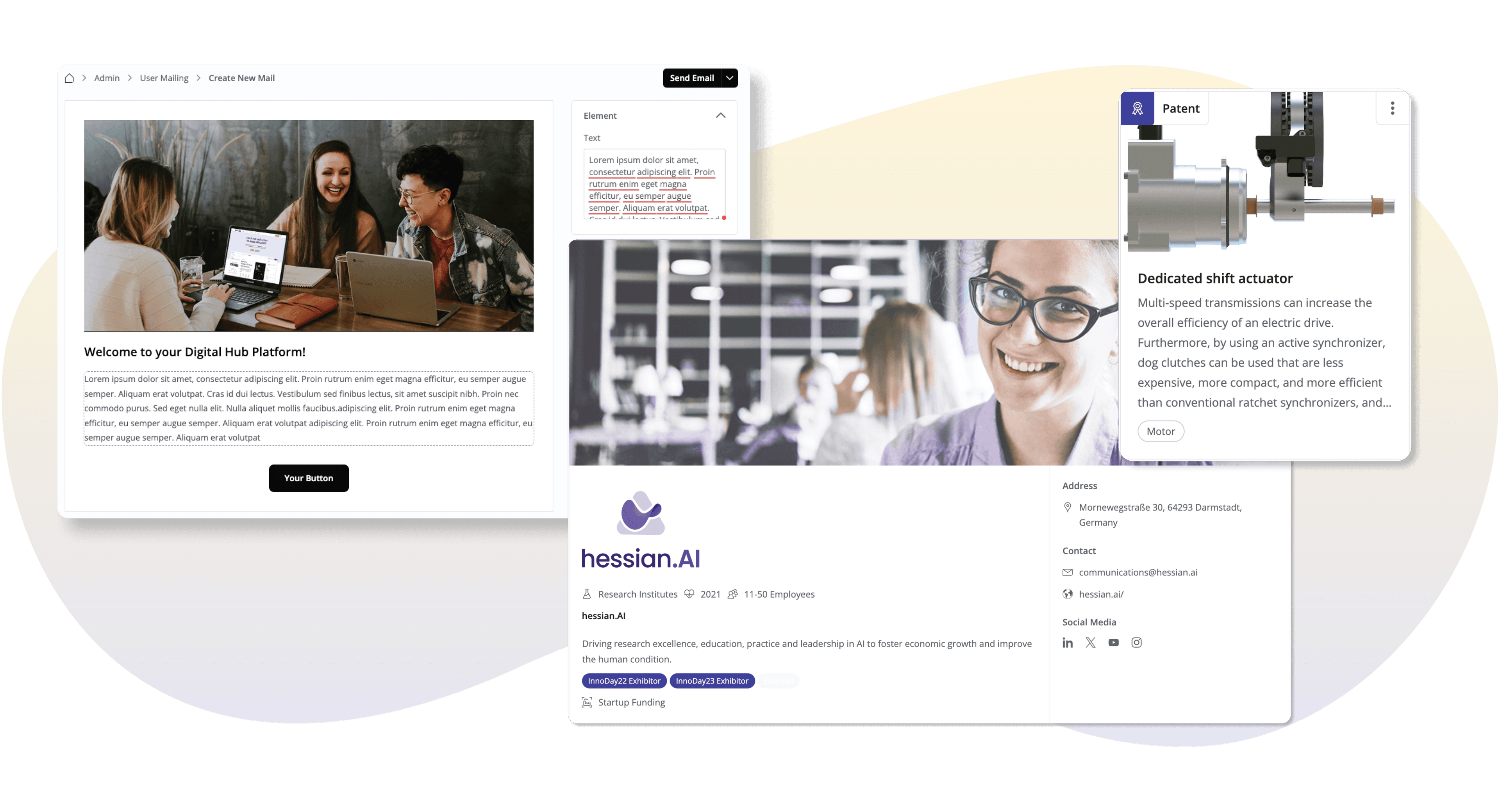
Keep industry partners always informed and engaged with automatic newsletters and targeted mailing tools.
Centralize stakeholder data
Structure and manage all your important stakeholder data with extremly customizable organization and member profiles.
Highlight IP portfolio
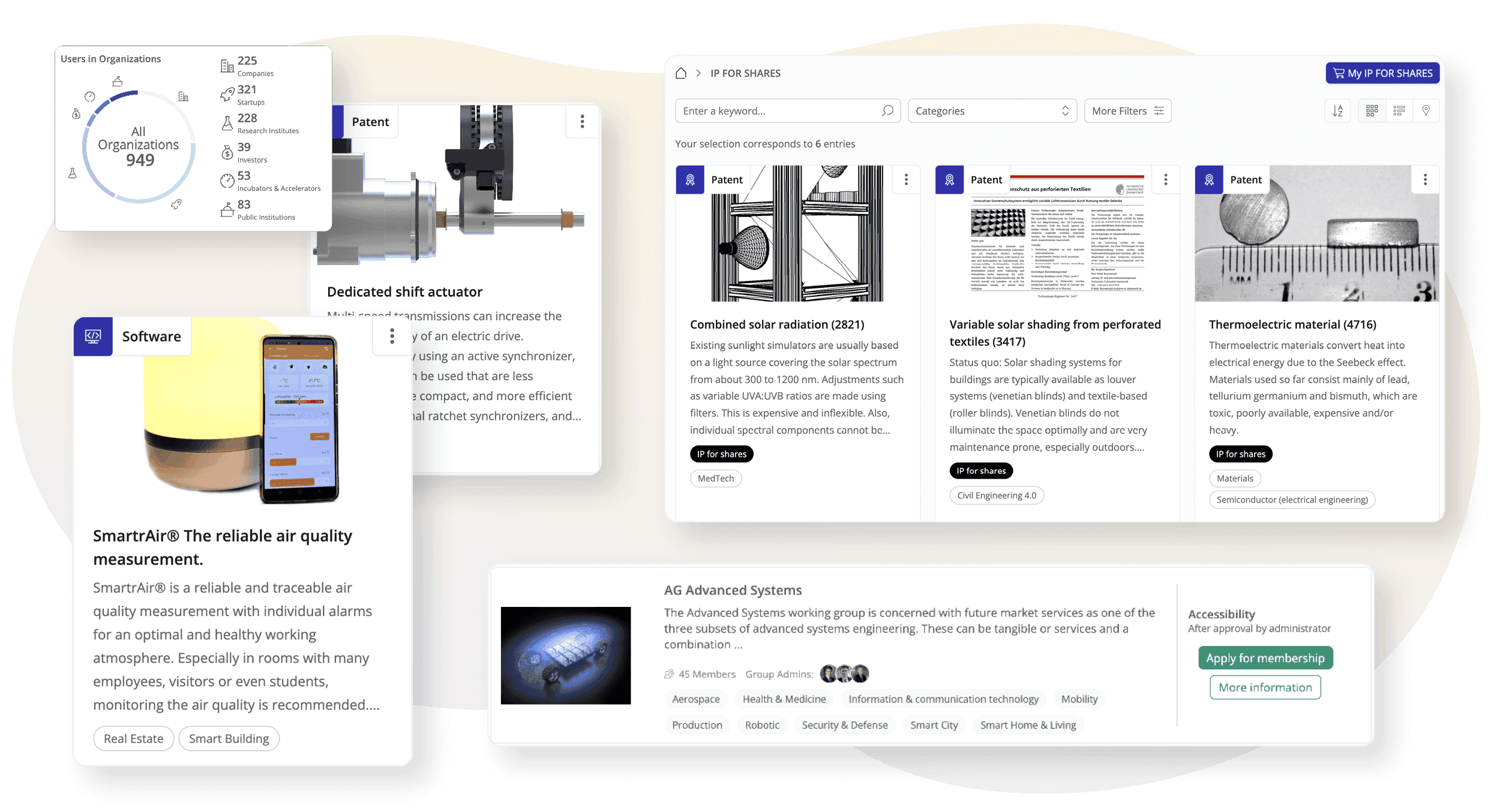
Create a comprehensive portfolio of your patents and research results in an attention-grabbing database that attracts the right industry interest.
Tracking valuable research results doesn't have to be time-consuming
Quickly align valuable industry partners with your most relevant research findings.
Research in sync
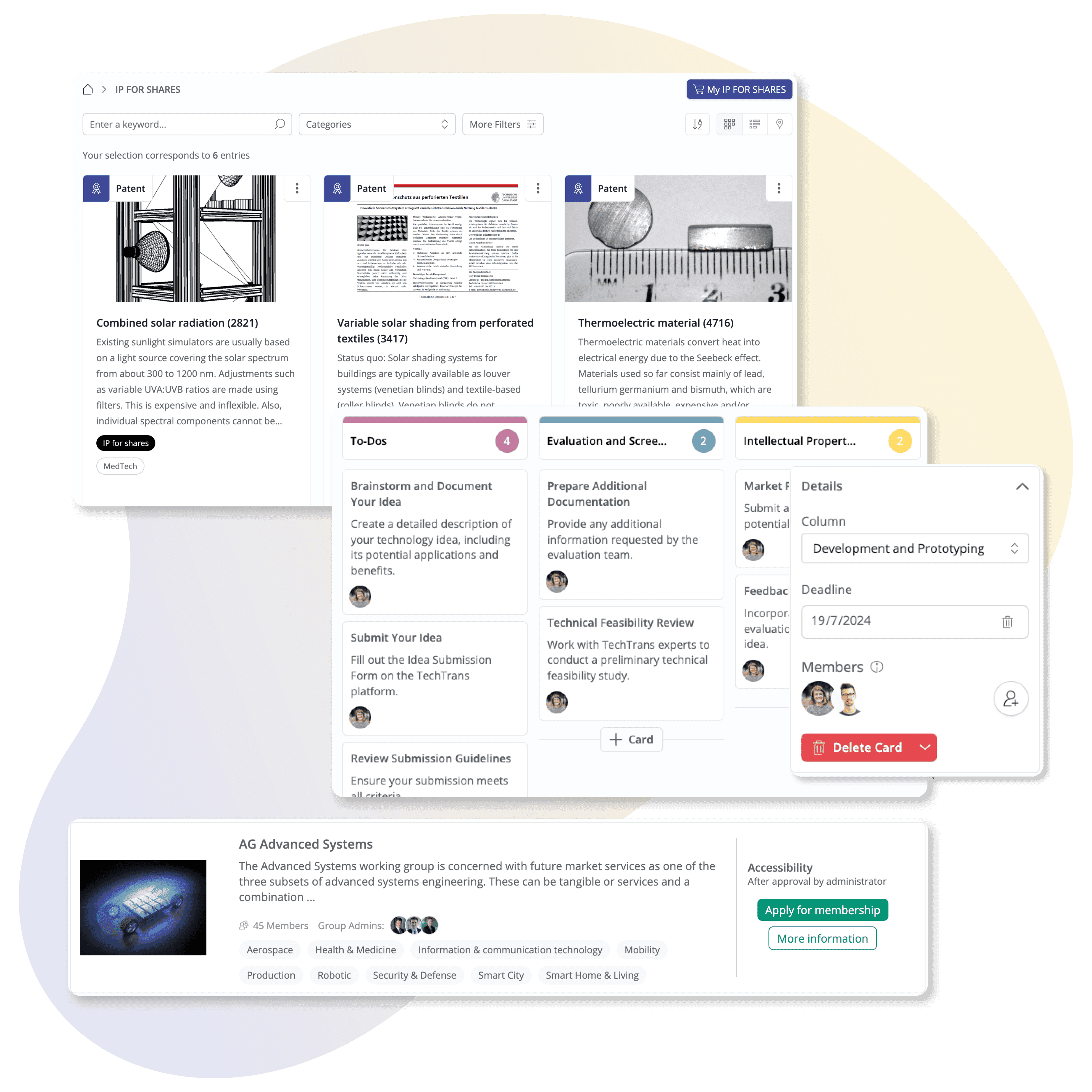
Centralize your research data effortlessly with customizable databases for patents, institutions, researchers, and results.
Streamline workflows visually
Map processes and manage collaborative workflows smoothly with intuitive, integrated Kanban boards.
Connect research to market
Create a centralized research ecosystem matching startups, investors, companies, and institutions to research findings and transfer offers.
Work in close partnership
Make communication and document sharing easy with specialized groups that revolve around your research projects, goals, or findings.
Your idle research equipment
is costing you money
Easily create digital marketplaces to convert your services
into thriving revenue streams.
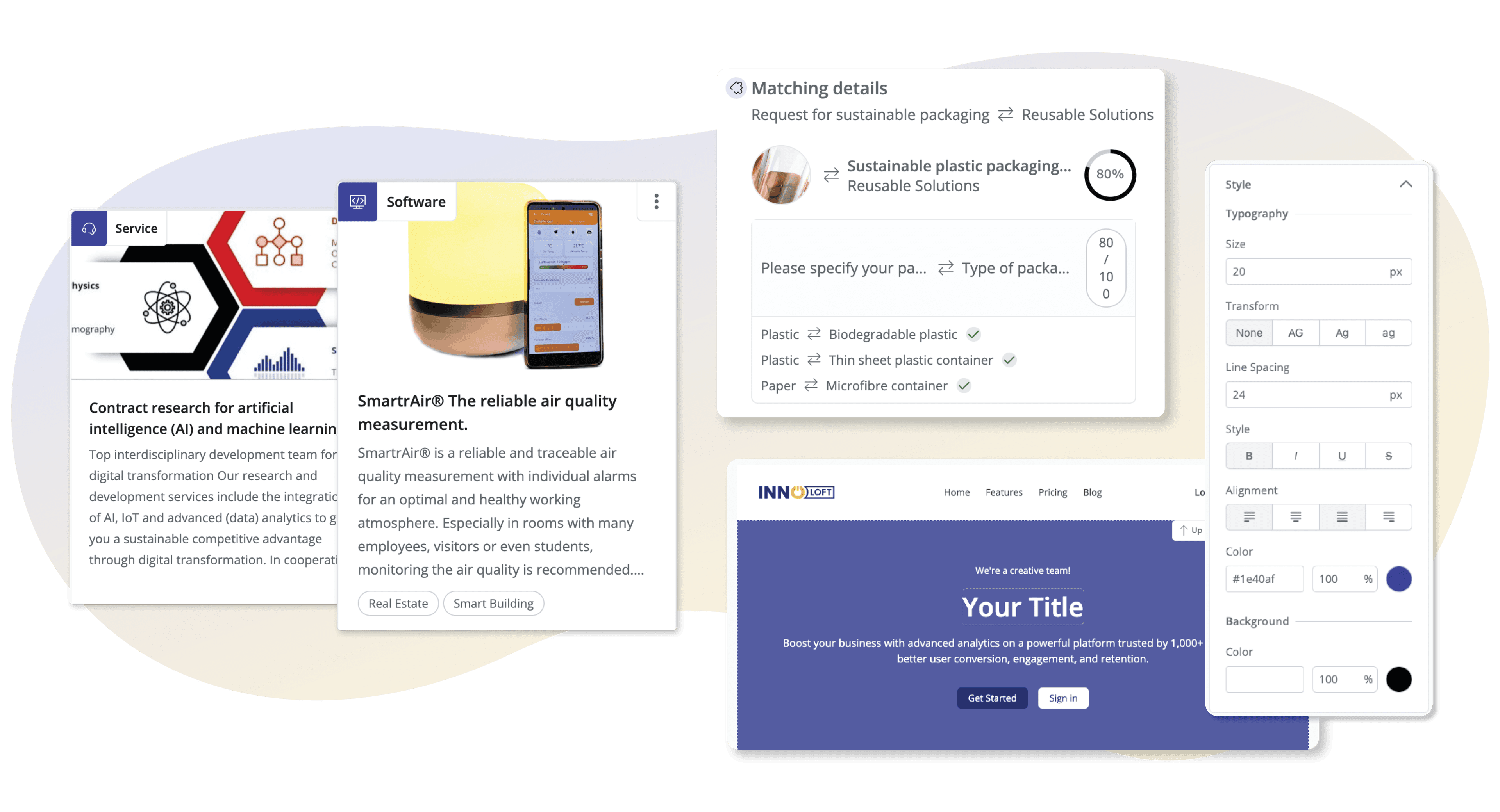
Monetize your machinery
Easily create a segmented marketplace to showcase your research equipment and services to external parties.
Automated matchmaking magic
Let customizable matching algorithms pair your equipment with those who need it most, no manual labor required.
Spotlight available equipment
Our integrated no-code website builder helps create stunning pages that promote your available research equipment without external effort.
Hard time inspiring entrepreneurial spirit
in your researchers?
Arm your researchers with intuitive tools to master their commercialization journey.

Empower entrepreneurial researchers
Equip researchers with the business skills they need through customizable e-learning courses and programs.
Accelerate research commercialization
Create a digital accelerator program like a personal trainer to guide researchers in identifying markets, validating needs, and assessing viability.
Engage with targeted events
Host any type of webinars, courses and training sessions that promote knowledge transfer with the best communication tools.
Inspire with success stories
Inspire your research ecosystem with actionable best practices, success stories, and business tips through specialized groups and engaging blog articles.
Effortlessly showcase your TTO's impact and success
Gain laser-sharp visibility of your Tech Transfer metrics
and effectively communicate your success.
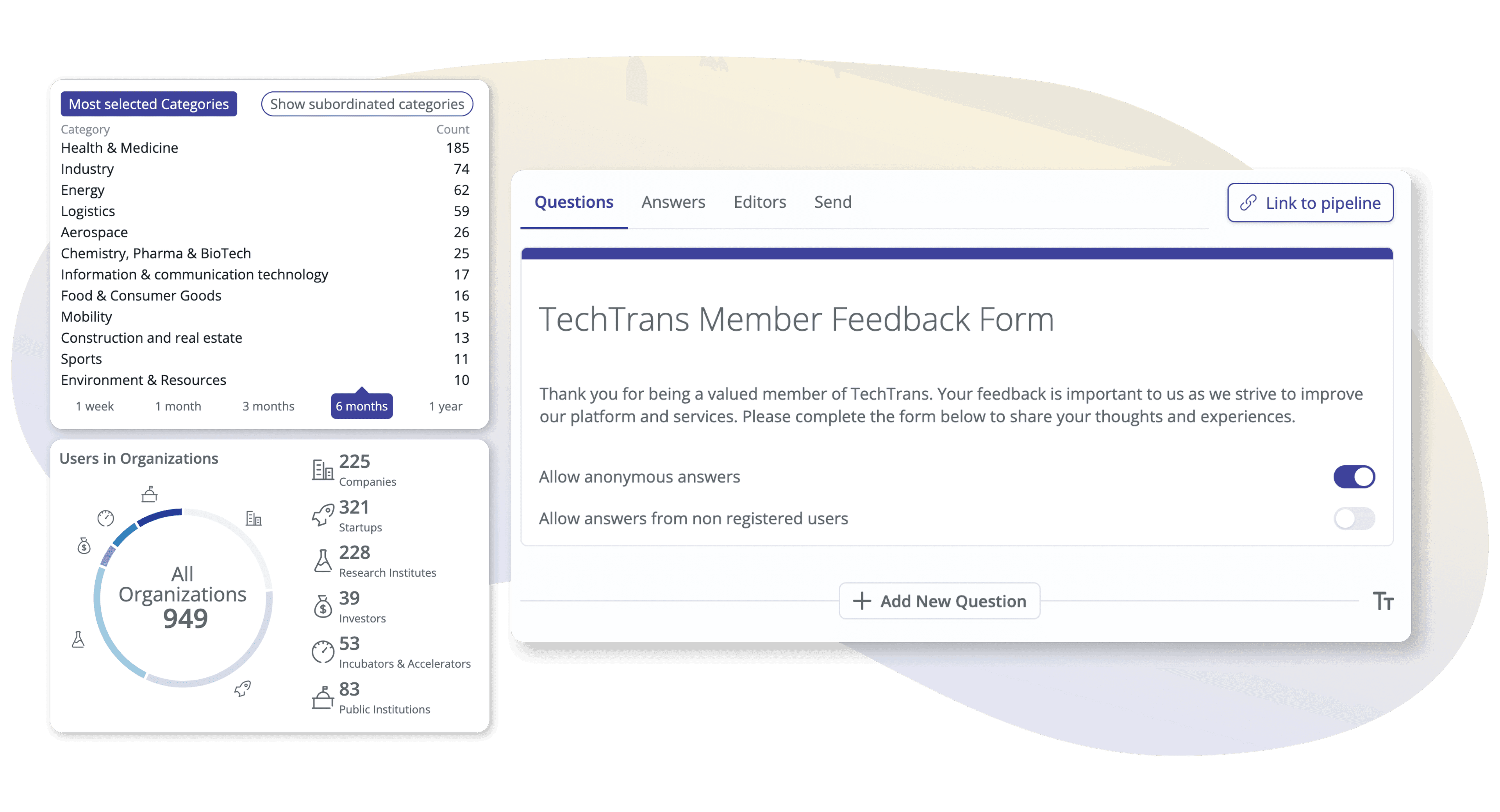
Showcase your impact
Easily track platform usage and demonstrate the value of your TTO with an insightful analytics dashboard.
Measure what matters
Define key transactions, set clear KPIs, and align platform features to your TTO's main objectives.
Insights on tap
Create customized forms and surveys to collect and analyze important user data seamlessly within your platform.
What are you waiting for?
Start building your technology transfer platform today!
Leverage the advantages
of our no-code platform
Be your own developer
Fast-track your digitalization journey
Cut software development cost by 80% with no-code flexibility
Find more insights related to building your own technology transfer platform

Best practices
6 Best Practice Tips for Technology Transfer to Accelerate Innovation
Turning your groundbreaking research into real-world miracles. It's not an easy process, right? You've got these incredible innovations practically bursting at the seams to change the world as we know it, but they're stuck in the lab. Why? Because the tech transfer process at most universities and research centers is like trying to run a marathon with your feet tied.Outdated systems, endless red tape, and workflows that make snails look speedy.The mountains of paperwork, tangled licensing negotiations, and clunky data tracking systems can leave you feeling drained. Not to mention the frustration that arises when a promising prototype just sits unused because industry connections haven’t materialized.Yet, here's the twist: These challenges aren't roadblocks; they're stepping stones. This guide walks through the technology transfer process and six best practices that help research institutions and technology transfer offices (TTOs) move innovations to market faster.Quick Answer: What Are Technology Transfer Best Practices?Technology transfer best practices are proven habits that move research results, intellectual property (IP) or processes from one organization or development stage to the next with fewer delays. For research institutions and TTOs, six matter most:Build long-term industry partnerships instead of one-off dealsSet a clear IP policy that defines ownership and licensing prioritiesSimplify licensing with standard term sheets, bundled and non-exclusive licensesTreat patent portfolio analytics as an ongoing processInvest in digital infrastructure that centralizes offers, contacts and collaborationPlan the route to market early – market demand, partners and contractsNote: "Technology transfer" has two common meanings. In pharma and manufacturing it means moving a process from a sending to a receiving site (for example scale-up or a handover to a contract manufacturer). At universities and research institutes it means turning research and IP into licenses, partnerships and spin-offs. This guide focuses on the second meaning and uses pharma examples where they show the same challenges.What Are the Benefits of Technology Transfer Best Practices?Tech transfer is critical for bringing innovations from the research lab to the market.It involves sharing technical knowledge, expertise, and resources between organizations. This collaborative process may uncover crucial insights, such as regulatory requirements, important parameters for scalability, and potential market applications.By engaging in technology transfer, researchers can also gain valuable feedback and guidance from industry partners. On top of that, incentives for researchers, such as royalties and licensing fees, encourage the development of novel technologies.For instance, a well-established biopharma company can provide funding, manufacturing capabilities, and market access to accelerate the translation of academic research into life-saving therapies.However, the process is not often as smooth as it seems. What Makes Technology Transfer So Slow?Ever wonder why tech transfer feels like a snail race? It's not just you.The process can be bogged down by a lack of standardized transfer methodology, unclear communication guidelines, and management hiccups. It's like trying to cook a complex meal, but everyone in the kitchen speaks a different language and the recipe keeps changing. Effective technology transfer requires a deep understanding of the technology and the ability to identify critical process parameters at various stages of technology development. This is where having a well-defined transfer methodology becomes crucial.For example, the biopharmaceutical industry is one sector where technology transfer may face significant delays, particularly when it comes to pharmaceutical manufacturing.Two common types of tech transfer are horizontal transfer and vertical transfer.What is the Horizontal Transfer Method? Horizontal transfer refers to the transfer of technology between two similar organizations or departments, such as two pharmaceutical companies or two academic institutions. This type of transfer often involves sharing knowledge, processes, and technology transfer best practices to enhance innovation and productivity.What is the Vertical Transfer Method? Vertical transfer, on the other hand, involves the transfer of technology from one stage of development to another within the same organization. For example, transferring a drug candidate from the discovery phase to the clinical trial phase within a biopharma company.While there are other methods of tech transfer, these two are among the most common and critical for effective transfer of technology.That's tech transfer process for you. It's about transferring not just information, but expertise, processes, and assets – and doing it efficiently is a real art form.Which takes us to our next question. Why Are Tech Transfers Difficult?With so many methods of technology transfer, no doubt, tech transfers can feel like navigating a labyrinth. To illustrate this a bit, a 2020 McKinsey & Co study on ramping up COVID-19 vaccine production highlighted a startling fact: in pharmaceutical manufacturing, tech transfers for sterile dosage forms such as injectable vaccines take from 18 to more than 30 months. And here's a twist – when you're passing the torch between different companies, it's even trickier. According to the same study, transfers to an external party take on average 5.8 months longer than internal ones. Differences in critical processes, standard operating procedures and IP ownership questions add friction.Adding to this complexity are management and product-related delays.Let's look at them in detail. Management-Related Delays from the Transfer TeamThese often arise from challenges in project management, such as inadequate planning, unstructured data, reliance on paper-based systems, and limited collaboration. Additionally, communication issues play a significant role. With various parties involved, clear and effective communication is critical to ensure a smooth technical transfer processAnd it's not just about time: every extra month ties up budget, staff and lab capacity that could go into the next project.Product-Related DelayProduct-related delays in tech transfer can stem from various scientific and technological challenges. These may include:Insufficient understanding of the product and its critical quality attributesInadequate process characterization and validationLimited manufacturing capacity, changes in equipment or incompatible equipmentDifficulty in establishing analytical methods and ensuring comparability between the original and transferred productDelays can also arise from issues related to manufacturing processes, particularly when the process to be transferred involves complex or new techniques.Overcoming these hurdles requires a thorough assessment of the product, process, and receiving site capabilities. By identifying potential gaps and proactively addressing them, organizations can minimize product-related delays and ensure a successful tech transfer.So can we transform tech transfer and make it more efficient? (hint: this is why you need the tech transfer tactics below).6 Best Practices for Successful Technology TransferTo optimize tech transfer efficiency and streamline the process, it's essential to adopt proven tech transfer tactics.Every transfer project is unique, but there are certain technology transfer best practice tips that can be applied across various industries and scenarios.By implementing these tech transfer tactics we're about to give you, organizations like yours can help to identify critical factors that influence the outcome and minimize potential obstacles.Embracing these strategies not only enhances tech transfer efficiency but also saves valuable time and resources, enabling faster commercialization and maximizing the impact of innovative technologies.Here are 6 tips to help you develop a comprehensive transfer plan for better tech transfer.1. Build Relationships with Industry PartnersFirst and foremost, when we talk about making the entire process of tech transfer more efficient, we have to open up by saying that building a strong relationship with the companies can't be underestimated. These partnerships will lead to transforming your process of technology transfer and make it more efficient.From developing more flexible patent licensing to accessing additional research funding to scale up your research, there are many reasons why companies and universities should develop a closer collaboration. Building a strong technology transfer team that can effectively collaborate with industry partners is essential for successful technology transfer.Let's put it this way, when close collaborations with outside institutions are formed, not only does freedom of communication and sharing of resources can be accelerated, but also your skills and perspectives can be widened to translate your research into effective real-world solutions.Also, did we mention that partnerships defined this way will greatly help make breakthrough technologies commercialized faster and cheaper?2. Develop a Clear IP PolicySo why does a clear IP policy matter?Well... Let's put it this way: Without clear IP policies tailored to the specific needs of your organization, ambiguity reigns.A transparent intellectual property policy serves as the cornerstone guiding effective technology transfer tactics. And it is critical to the success of research and development institutions in commercializing their innovations.A clear IP policy should also address potential risk management concerns, such as identifying and mitigating risks associated with technology transfer.Clear IP rights policies help to protect new IPs and ensure that technology transfer processes are executed properly.This also allows institutions create certainty around commercialization avenues and allow for the sharing of information.Speeding up progress from the lab to real-world impact, ensures that ideas and innovations are protected in the best way possible while also promoting collaboration.Without a clear IP policy, researchers may question their permission to patent discoveries or collaborate with corporate partners. External stakeholders might face confusion navigating academic bureaucracies for securing licensed innovations, slowing time-to-market.In short, a detailed IP policy eliminates guesswork by defining ownership and clarifying licensing priorities.Once IP guidelines firmly take shape, tech transfer institutes must actively curate their patent and licensing portfolios as prioritized assets that set technology transfer in motion. By employing tech transfer platforms such as LoftOS (our own product), you can manage your IP portfolios in one central place, list transfer offers from all institutes and researchers and display opportunities to industry partners to enhance collaboration.3. Simplify the Licensing ProcessAre you still lost in licensing limbo? Maybe it's time to cut through the red tape.Navigating the licensing labyrinth often feels like wandering aimlessly while your innovation waits impatiently. Specially, with the wide variety of licensing agreements available to transfer knowledge from lab to market.But what if you could highlight simpler pathways to partnerships? Let's explore a few ways you can make it easier for everyone involved to get down to business and ensure the process is run smoothly:Standardize Agreements: Have a ready-made template term sheets that align expectations upfront, accelerating review cycles from months to days by preventing repetition of known deal elements.Bundle Up with Packaged Licenses: Curate complementary patents into targeted portfolios solving industry problems; the convenience encourages licensing en masse rather than one-off.Play It Smart with Non-Exclusive Licenses: With Non-exclusive licenses, you can increase flexibility and regional focus to expand entrepreneurial runways, delivering more deals without monopolistic strings that stifle downstream progress. By aligning systems around responsibility, transparency and speed, you transform from reactive administrators to proactive superheroes in the quest to move life-changing technologies off of paper and into the real world where they belong.4. Patent Portfolio Analytics is an Active ProcessPatent Portfolio Analytics is a crucial part of technology transfer, helping you understand the value of your inventions and make informed decisions about how to develop and commercialize them for commercial production.Think of it like analyzing your collection of patents as if it were a stock portfolio. By examining your patents, you can identify your strengths in specific technology areas and spot potential gaps. This knowledge can guide you in deciding which technologies to prioritize for further development, or where to seek partnerships with companies possessing complementary technologies.Patent portfolio analytics involves a deep understanding of the technology and process knowledge to identify critical aspects for successful transfer.In the context of knowledge transfer, Patent Portfolio Analytics enables you to pinpoint companies with relevant patents that might be interested in licensing your technology or collaborating to bring the product to market.By actively engaging Patent Portfolio Analytics, you can stay ahead of the curve, maximize the potential of your inventions, and pave the way for successful tech transfer tactics that lead to commercialization.5. Invest in Digital InfrastructureAt this point in time, investing in digital infrastructure tailored to the specific needs of your organization should be a given. Here are 4 reasons why we think investing in digital infrastructure is the gateway to a more efficient, more collaborative, and more successful tech ecosystem for your organization.It facilitates collaboration and sharing of research. Having robust digital tools and infrastructure like shared drives, project management platforms, video conferencing etc. makes it much easier for researchers across different labs, departments or institutions to collaborate. This cross-pollination speeds up innovation process optimization.It supports virtual technology transfer. With more digital capabilities, tech transfer offices can host things virtually like showcases for industry partners to see available technologies, pitch events for startups and entrepreneurs to present licensing opportunities, and enable remote due diligence. This expands opportunities despite geographic limitations and enhances sending and receiving information.It assists with large data processing. So many areas of innovation today involve analyzing or translating large datasets. Having access to cloud computing capabilities, AI tools and high-powered computing is crucial for handling modern data-intensive research areas like genomics, self-driving cars etc.It enables better IP protection. We can't stress this one enough! By utilizing secure collaboration portals and robust data tracking, institutions can better identify, protect and document IP created by their researchers. This also supports tech transfer activities later on.As you can see, a technology transfer office can easily centralize their operations to improve communication and facilitating cross-functional collaboration by going digital. This investment not only accelerates the transfer of innovative technologies but also positions institutions, like yours, as leaders in the digital age.Let's talk about how this process looks and how it can help you team up with partners who are on the same page as you.6. Transitioning Research into the MarketplaceLast but not least, we can’t talk about technology transfer best practices without talking about making money.Understanding the technology transfer lifecycle is essential for successfully commercializing research findings. Technology transfer tactics also requires careful consideration of market demand and potential partnerships.To successfully transition research, consider both the process and the product.Understand market demand, identify partners, and navigate contract development complexities.You can also come back and look at these robust tech transfer tactics to streamline the process and protect intellectual property.To overcome these challenges, consider digitalizing your technology transfer process to centralize information, automate workflows, and facilitate collaboration, ultimately maximizing the value of your intellectual property.So, once you've figured out what you want to achieve and what you need to get there, the next step is to network. Maximize the Value of Your Intellectual Property with a Streamlined Technology Transfer PlatformNetworking is also crucial for research institutions to find collaborators with complementary skills and resources.However, managing these aspects manually can be challenging.High manual effort in finding partners, communicating with researchers, and keeping information up-to-date hinders efficiency.Is there a better way to look for these partners?There are a bunch of places you can look to find these potential partners. You can try checking out online databases, tapping into networks, attending events, asking for referrals, or even keeping an eye on relevant publications. But since we're dealing with efficiency here, why not jumpstart collaborations on one centralized platform, purposely-built to catalyze successful technology transfer commercialization.Our no-code platform LoftOS centralizes tech transfer processes in an all-in-one solution so you can:Store both IP offers and your network contacts without hassleIncrease the visibility of your IP portfoliosShowcase innovations to ideal partners with easeSupport spin-offs with co-founder matchingMatch technology offers with industry partners using AI matchmaking (generally available since the Matching 3.0 release)Finally, a digital hub designed by innovation pros for innovation pros. Two examples from our own customer base: the ITA Group (Institut für Textiltechnik of RWTH Aachen University) runs TexSpace, a textile hub that connects research, startups and investors. HUMBOLDT-INNOVATION, the interface between science and industry at Humboldt-Universität zu Berlin, built match'em, a co-founder matchmaking platform that pools the resources of Freie Universität Berlin, Humboldt-Universität zu Berlin, Technische Universität Berlin and Charité – Universitätsmedizin Berlin.With LoftOS you increase the visibility of your IP, nurture relationships with stakeholders and grow research commercialization on one platform. Get started for free and try our technology transfer platform. FAQ: Technology Transfer Best PracticesWhat are the main methods of technology transfer?Between organizations, the classic routes are licensing IP, research collaborations with industry, and spin-offs that commercialize a technology themselves. Within an organization, technology moves vertically from one development stage to the next; between similar organizations it moves horizontally.What are the typical stages of technology transfer?At research institutions, most transfers follow the same path: invention disclosure, assessment and IP protection, marketing and partner search, a license agreement or spin-off, and follow-up support until the technology is on the market.What does a technology transfer office (TTO) do?A TTO evaluates inventions, protects IP, finds industry partners and licensees, negotiates agreements and supports founders of spin-offs. Its goal is to turn research results into products and services that reach the market.How long does technology transfer take?It depends on the field. In pharmaceutical manufacturing, McKinsey found that tech transfers for sterile dosage forms take from 18 to more than 30 months. In academic licensing, clear IP policies, standard agreements and a central platform for offers and contacts shorten the time to a signed deal.
Best practices
Technology Commercialization: Accelerating Technology Transfer in Europe with Innovative Strategies
Technology commercialization is the process of turning research results, such as inventions, know-how, software or data, into products, services or processes that are used in the market. In practice it runs through a few stages: disclosing an invention, assessing its potential, protecting the IP, finding a partner and closing a deal, typically a licence, a spin-off or a joint research project.
Disclosure: Innoloft builds LoftOS, the platform we describe in this article.
The world of technology transfer - the process of translating scientific findings from academic research into practical applications - has long relied on manual work: emails, spreadsheets, paperwork and face-to-face meetings.
As Deloitte's report on the future of tech in Europe outlines, the region has often been viewed as a tech wasteland, struggling to keep up with the pace of modern innovation.
It's a world characterized by intricate negotiations, a maze of stakeholder interests, and a pace that, in many cases, can't keep up with the speed of modern innovation.
These outdated methods can lead to delays, miscommunication, and a lack of transparency. They also make it difficult to manage and track the progress of tech transfer initiatives, which can result in missed opportunities and wasted resources.
The Technology Commercialization Process: 6 Stages
Most technology transfer offices (TTOs) follow a similar sequence, even if they name the stages differently:
Invention disclosure: a researcher reports a result with commercial potential to the TTO.Assessment: the TTO checks novelty, market potential and possible partners.IP protection: depending on the result, a patent application, copyright or protection of know-how.Marketing and partner search: the technology is described as an offer and presented to companies, investors or founders.Negotiation and deal: the parties agree on a licence, a spin-off or a research collaboration.Follow-up: milestones, royalties and the relationship with the partner are managed over time.
Commercialization Pathways: Licensing, Spin-offs and Collaborative Research
Licensing: a company gets the right to use a patent or know-how in return for fees or royalties. This works well when an established firm can bring the technology to market faster.Spin-off: researchers found a company to develop the technology themselves, often with a licence from their university.Collaborative and contract research: a company and a research team develop the technology further together, or the company commissions specific research.Open innovation challenges: companies publish a problem and research teams propose solutions. This helps to find demand before a technology is fully developed.
For practical tips on running a transfer office, see our article on technology transfer best practices.
Is There a Better and Faster Way for Technology Transfer?
LoftOS is our answer to this challenge: a platform that brings researchers, transfer offices and companies together in one place.
Instead of scattered emails and spreadsheets, technology offers, partner requests and conversations sit on a shared platform, which makes the process easier to follow for everyone involved.
Below we look at the typical challenges of technology transfer, how a platform supports each step, and how universities and research institutes use LoftOS.
The Complexities of Technology Transfer: A Modern Challenge
In the realm of academia and industry, technology transfer is a critical yet complex process. It's the bridge that transforms the research community results into innovative products, services, and processes.
Yet, it's a bridge that's often fraught with challenges.
From the intricate dance of negotiations between researchers, technology transfer offices, industry partners, and policymakers, to the challenges of commercialization and regulatory compliance, the complexities are manifold.
These complexities are further compounded by the traditional approach to technology transfer, which often lacks the efficiency, speed, and effectiveness that today's fast-paced world demands.
These are the key challenges in research transfer:
Understanding Technology Transfer Challenges
Balancing Interests: Navigating the diverse interests of stakeholders, including the researcher community, industry partners, and policymakers, can be challenging.
Commercialization Challenges: Transforming research into a marketable product requires significant resources and expertise.
Funding Constraints: Securing adequate funding for both research and its subsequent commercialization is often a hurdle.
Regulatory Compliance: Adhering to a complex landscape of laws and regulations related to intellectual property and technology transfer can be daunting.
Time Constraints: The technology transfer process can be lengthy, often spanning years from initial research to final product.
Lack of Expertise: Universities may lack the necessary business and commercialization expertise to effectively transfer technology to the market.
Cultural Differences: Bridging the gap between the academic and business worlds can pose challenges in technology transfer.
But, imagine if there were a more efficient method to navigate these complexities – one that harnesses the power of digital transformation to streamline the research transfer process.
That's where LoftOS comes into play.
The Power of Digital Transformation: Enter Technology Transfer Platforms
In an era where digital transformation is reshaping every industry, the field of technology transfer is no exception.
The digital revolution is not just about adopting new technologies; it's about fundamentally changing how we operate and deliver value.
This is not just about replicating an existing service in a digital form, but to use technology to transform that service into something significantly better. It's not just about understanding the potential of technology, but about understanding how it can change business for the better.
So, how exactly is LoftOS making a difference in technology commercialization?
Success Stories: Accelerating Technology Commercialization Success with LoftOS
Here are examples of institutions that have used LoftOS for their transfer work.
With a technology transfer platform, technology offers, requests and contacts are in one place, which makes it easier for researchers and companies to find each other.
HUMBOLDT-INNOVATION: match'em by Science & Startups
HUMBOLDT-INNOVATION runs match'em, a co-founder matchmaking platform built with LoftOS. It pools the resources of Freie Universität Berlin, Humboldt-Universität zu Berlin, Technische Universität Berlin and Charité, and helps people from these institutions find co-founders for new ventures.
Technical University Darmstadt: HIGHWAY
Technical University Darmstadt used LoftOS for its digital innovation platform HIGHWAY. It offered a range of support services, from connecting researchers with companies to help with patent applications and the creation of spin-offs. The HIGHWAY platform is no longer online.
Fraunhofer Institute for Mechatronic Systems Design (IEM)
At Fraunhofer IEM, the future is being engineered today.
With LoftOS, they've been able to build a thriving digital community centered around Advanced Systems Engineering, as well as streamline both internal and external communication.
They also use it to manage and showcase their projects.
The result? A more efficient tech transfer process that improves their ability to bring innovative ideas to life.
These examples show how a shared platform supports day-to-day transfer work: making offers visible, connecting the right people and keeping track of projects.
If you want to test this for your own institution, you can start with a free LoftOS platform.
How a Platform Supports Technology Commercialization: An Example
Picture this: a European research institution has made a promising discovery for the medical industry.
However, as expected, they face numerous challenges in transferring their research from the lab to the market. Complex negotiations, lack of transparency, and slow commercialization processes threaten to hinder the innovation's impact.
This is where a technology transfer platform such as LoftOS helps.
Communication and Transparency
Imagine if this institution had access to a platform where they could effortlessly collaborate with stakeholders, including technology transfer offices, industry partners, and policymakers.
LoftOS makes this possible by providing a centralized communication hub that keeps everyone on the same page.
With LoftOS, researchers can easily share updates, monitor progress, and track the tech transfer process at every stage. This enhanced transparency makes the process more efficient and builds trust among all parties involved.
Finding Industry Partners with AI Matchmaking
Now, let's consider the technology commercialization process.
The researcher from our example needs the right industry contacts to bring the discovery to market.
LoftOS also simplifies this journey by directly linking them with industry demand.
LoftOS uses AI matchmaking to connect technology offers with company requests. With Matching 3.0, platform operators decide which profiles are matched and how members see their matches, for example as a list or as suggestions released over time. Read more about customizable AI matchmaking and about how transfer platforms fit into a wider technology ecosystem.
This shortens the search for partners and makes it more likely that a discovery reaches the companies that can use it.
Managing the Whole Transfer Process in One Place
From connecting with potential industry partners to simplifying the commercialization process, LoftOS helps you unlock the full potential of your discovery by providing a comprehensive platform where you can manage all aspects of the tech transfer process.
It doesn't replace the work of transfer managers, but it makes that work easier to organize and track.
Remember, the power of digital transformation lies not just in adopting new technologies, but in using these technologies to fundamentally change how we operate and deliver value.
The goal is not just to digitize existing steps, but to make technology transfer more transparent and easier to manage for researchers, transfer offices and companies.
FAQ: Technology Commercialization
What is technology commercialization?
It is the process of turning research results into products, services or processes that are used in the market, usually through licensing, spin-offs or collaborative research.
What is the difference between technology transfer and technology commercialization?
Technology transfer is the broader term for moving knowledge from research into practice, including publications, consulting and joint projects. Technology commercialization is the part that aims at market use and economic value, for example through licences or spin-offs.
What are the main commercialization pathways?
Licensing, spin-offs, collaborative or contract research, and open innovation challenges in which companies publish problems for research teams to solve.
Who is responsible for commercialization at a university?
Usually a technology transfer office (TTO) or a separate transfer company. It supports researchers with disclosure, IP protection, partner search and negotiations.
How does software support technology commercialization?
A technology transfer platform makes offers and requests visible, matches researchers with companies, and keeps conversations and project status in one place. LoftOS, our product, does this with AI matchmaking and customizable modules.
Closing Thoughts
We envision a smarter and more efficient way to bring cutting-edge research and technology to society.
At Innoloft, we want to make technology commercialization simpler. With LoftOS, researchers and transfer offices have the tools to bring their discoveries to the right partners.
Universities and research institutes already run transfer platforms on LoftOS. Create your free platform and see how it supports collaboration and your innovation management process.
